August 12, 2026 Total Solar Eclipse

Quick Answer
A total solar eclipse will cross the Arctic on August 12, 2026, sweeping its path of totality across Greenland, Iceland, and northern Spain. Observers within this narrow path will see the Sun completely covered by the Moon for up to 2 minutes 18 seconds, revealing the solar corona in one of nature's most dramatic spectacles. Outside the path, a partial eclipse will be visible across most of Europe and North Africa. The August 12 eclipse occurs just 41 days before the Autumn Equinox on September 22, marking the transition from summer to fall.
Don't Miss Tonight: Perseid Meteor Shower
August 12 isn't just eclipse day, it's also the peak of the Perseid meteor shower. With the New Moon just one day prior, 2026 offers the best Perseid viewing conditions until 2028. Expect up to 100 meteors per hour in dark skies.
Perseid Meteor Shower 2026: Complete Viewing GuideWhat Is a Total Solar Eclipse?
A total solar eclipse occurs when the Moon passes directly between the Sun and Earth, completely blocking the Sun's photosphere, the bright surface we normally see, from view at specific locations on Earth's surface. This alignment is possible because of a remarkable cosmic coincidence: the Sun is roughly 400 times larger than the Moon, but it is also roughly 400 times farther away, making both objects appear nearly the same size in the sky.
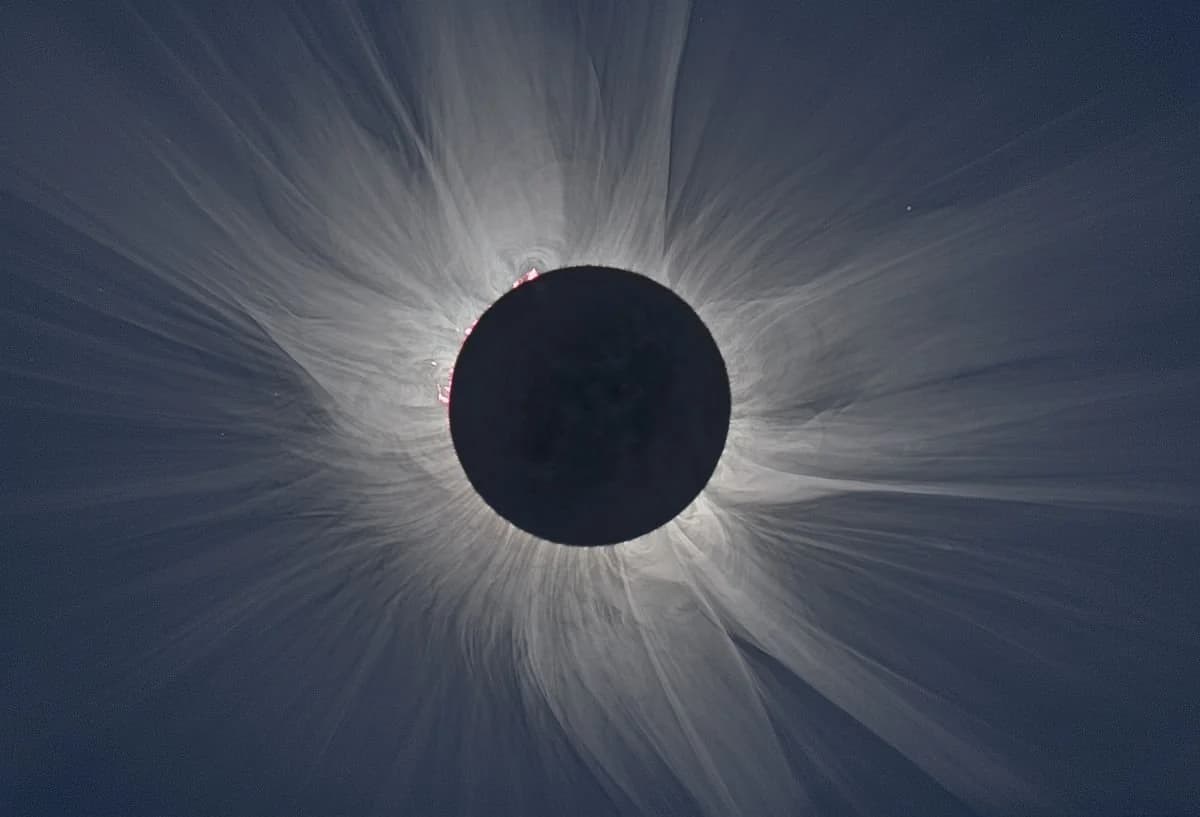
During totality, the Sun's brilliant disk is replaced by a black circle surrounded by the solar corona, the Sun's outer atmosphere, which is normally invisible because the photosphere is a million times brighter. The corona appears as a ghostly, pearly white halo with streamers extending outward in all directions, shaped by the Sun's magnetic field. It is one of the most awe-inspiring sights in all of nature.
Total solar eclipses are relatively rare at any given location. While they occur somewhere on Earth roughly every 18 months, the path of totality is extremely narrow, typically only 100–250 kilometers wide, meaning that any specific location on Earth experiences a total solar eclipse only once every 375 years on average.
The Science Behind the Alignment
For a total solar eclipse to occur, three conditions must be met simultaneously:
-
It must be a new moon: The Moon must be positioned between the Sun and Earth
-
The Moon must be near a node: The Moon's orbit must cross the ecliptic plane (Earth's orbital plane around the Sun), which happens at two points called nodes
-
The Moon must be close enough to Earth: The Moon must be near enough (close to perigee) that its apparent size equals or exceeds the Sun's apparent size
The Moon's orbit is not circular but elliptical, and its distance from Earth varies by roughly 50,000 kilometers between perigee (closest) and apogee (farthest). When a solar eclipse occurs while the Moon is near perigee, the Moon appears larger and can fully cover the Sun, producing a total eclipse. When the Moon is near apogee, it appears smaller and leaves a ring of sunlight visible, producing an annular eclipse instead.
The Path of Totality
The August 12, 2026 total solar eclipse follows a path that begins over northeastern Siberia and sweeps across the Arctic, western Greenland, southwestern Iceland, and northern Spain. The path is roughly 290 kilometers wide at its maximum and narrows at the endpoints.
Detailed Path Description
Siberia and the Arctic (15:34 UTC): The Moon's umbra first touches Earth's surface over far northeastern Siberia at sunrise, then tracks across the Arctic Ocean. This is a remote region with no permanent population, though research stations and expedition vessels may be positioned in the area. The Sun rides low on the horizon all along this northern stretch, creating potentially dramatic photographic opportunities.
Greenland (16:35–17:40 UTC): The shadow crosses western Greenland, passing over the ice sheet and the fjord regions before reaching the coast. This area has some of the most spectacular scenery on the planet, with towering cliffs, glaciers, and Arctic wildlife. However, access is extremely limited, requiring specialized expedition cruises or charter flights, and the Sun sits very low on the horizon here. Weather prospects are uncertain; August in Greenland often has mixed cloud cover.
Iceland (totality 17:43–17:50 UTC): The umbral shadow enters at Straumnes lighthouse in the Hornstrandir Westfjords, cuts a diagonal across the western half of the country, touching Ísafjörður, skirting Snæfellsnes, and crossing Reykjavík and the Reykjanes peninsula, making Iceland the most accessible location for this eclipse. Totality lasts 2 minutes 13 seconds at Látrabjarg, the longest on land anywhere along the path; the absolute maximum (2m 18s) lies just 45 km off the west coast at sea. The north and east of Iceland, including Akureyri and Egilsstaðir, see only a deep partial eclipse. Iceland's mix of dramatic landscapes, volcanoes, glaciers, geysers, and waterfalls, provides extraordinary foreground scenery for eclipse photography. However, Iceland's weather in August is notoriously unpredictable, with rapidly changing conditions. Eclipse chasers should plan multiple potential viewing sites and be prepared to move based on cloud forecasts.
Atlantic Ocean (17:50–18:25 UTC): The shadow crosses the North Atlantic between Iceland and Spain in roughly 35 minutes. Cruise ships positioned along the path offered passengers a viewing platform above the open ocean.
Northern Spain (18:25–18:35 UTC): The path of totality makes landfall in northwestern Spain in Galicia and sweeps across Asturias, Cantabria, Castile and León, Aragon, and the Valencian coast before the shadow leaves Earth over the Balearic Islands at sunset. This is the most populated section of the path, with cities like Gijón, Oviedo, Burgos, and Zaragoza offering accommodations and infrastructure. The Sun sits low (2–12° above the horizon), giving totality a dramatic sunset quality. August weather in northern Spain is generally favorable, with warm temperatures and a reasonable chance of clear skies, though afternoon thunderstorms can develop in the interior.
Key Locations Along the Path
| Location | Country | Totality Duration | Sun Altitude | Accessibility |
|---|---|---|---|---|
| Látrabjarg | Iceland (Westfjords) | ~2m 13s | ~23° | Hard (cliff edge, no road access, wind exposure) |
| Reykjavik | Iceland | ~1m 00s | ~25° | Easy (international airport) |
| Ísafjörður | Iceland | ~1m 30s | ~25° | Moderate (domestic flights/drive) |
| Akureyri | Iceland | partial ~98% | ~28° | Deep-partial zone only |
| A Coruña | Spain | ~1m 15s | ~12° | Easy (good transport) |
| Gijón | Spain | ~1m 45s | ~10° | Easy (good transport) |
| Oviedo | Spain | ~1m 48s | ~10° | Easy (good transport) |
| Santander | Spain | ~1m 02s | ~9° | Easy |
| Burgos | Spain | ~1m 44s | ~8° | Easy (high-speed rail) |
| Zaragoza | Spain | ~1m 24s | ~6° | Easy |
| Valencia | Spain | ~1m 00s | ~4° | Easy (coast; sunset eclipse) |
| Palma de Mallorca | Spain | ~1m 36s | ~2° | Easy (Sun on horizon) |
Best Places to Watch the Eclipse
In the Path of Totality
Iceland, The most accessible location for this eclipse. The path cuts diagonally across the western half of the country, from the Westfjords down through Reykjavik. Reykjavik gets approximately 1 minute of totality with the Sun 25° high, while Látrabjarg in the Westfjords enjoys the maximum on land (~2 minutes 13 seconds) and the waters off Iceland's west coast see the absolute maximum (2m 18s). Bring layers; August weather in Iceland is unpredictable, with rapidly shifting clouds and wind.
Northern Spain, Galicia, Asturias, Cantabria, Castile and León, Aragon, Valencia, and the Balearics all fall within the path. Cities like Gijón, Oviedo, Burgos, and Zaragoza offer excellent infrastructure and warm August weather. The eclipse occurs at sunset (~20:27–20:33 CEST), giving the event a dramatic sunset quality.
Greenland, Spectacular fjord-and-ice-sheet scenery, but the Sun is extremely low along the path and landfall is brief. Access is extremely limited, no regular commercial flights reach the path. Best suited for experienced Arctic travelers.
Partial Eclipse Visible From
- All of Europe, 50–90% coverage depending on location
- North Africa, 30–60% coverage across Morocco, Algeria, and Tunisia
- Northeastern North America, Partial at sunrise from eastern Canada
- Western Russia, 40–70% coverage
Check partial eclipse coverage for your specific location with our Time Zone Converter.
Eclipse Day: What to Expect Hour by Hour
The total solar eclipse unfolds over nearly three hours as the Moon's shadow races across the Earth from the Arctic to the Mediterranean. Here is the complete timeline in Coordinated Universal Time (UTC):
| Time (UTC) | Event | Location |
|---|---|---|
| 15:34 | First contact (partial eclipse begins) | Northeastern Siberia |
| ~17:04 | Totality begins over Greenland | Remote north-east coast (Station Nord, ~16s) |
| 17:43:28 | Totality reaches Iceland | Straumnes lighthouse, Hornstrandir (Westfjords) |
| 17:45:53 | Greatest eclipse (2m 18s duration) | Denmark Strait, 45 km off Iceland |
| ~17:50 | Totality ends in Iceland | Southeast of Reykjavík |
| ~18:25 | Totality begins in Spain | Galicia / Bay of Biscay coast |
| ~18:33 | Totality ends in Spain | Balearic Islands (setting Sun) |
| 19:58 | Partial eclipse ends, shadow leaves Earth | Central Mediterranean / N Africa |
All times are in Coordinated Universal Time (UTC). Convert to your local time zone to plan your viewing.
Exact Timing by Location
The following table provides approximate local times for all four eclipse contacts at selected cities. First contact (C1) is when the Moon first touches the Sun's edge; second contact (C2) is the beginning of totality; third contact (C3) is the end of totality; fourth contact (C4) is when the Moon completely leaves the Sun's disk.
| Location | C1 (Partial Begins) | C2 (Totality Begins) | C3 (Totality Ends) | C4 (Partial Ends) |
|---|---|---|---|---|
| Reykjavik, Iceland | 16:47 GMT | 17:48 GMT | 17:49 GMT | 18:47 GMT |
| Keflavík, Iceland | 16:47 GMT | 17:48 GMT | 17:50 GMT | 18:48 GMT |
| Gijón, Spain | 19:31 CEST | 20:27 CEST | 20:28 CEST | 21:20 CEST |
| Oviedo, Spain | 19:31 CEST | 20:27 CEST | 20:29 CEST | 21:21 CEST |
| Burgos, Spain | 19:33 CEST | 20:28 CEST | 20:30 CEST | 21:21 CEST |
| Zaragoza, Spain | 19:34 CEST | 20:29 CEST | 20:30 CEST | 21:21 CEST |
| Valencia, Spain | 19:38 CEST | 20:32 CEST | 20:33 CEST | 21:24 CEST |
| London, UK | 18:17 BST | , | 20:06 BST | |
| Paris, France | 19:22 CEST | , | 21:09 CEST | |
| Berlin, Germany | 19:15 CEST | , | 20:58 CEST | |
| Oslo, Norway | 19:02 CEST | , | 20:49 CEST | |
| Madrid, Spain | 19:36 CEST | , | 21:24 CEST |
Note: Times are approximate and may vary by 1–2 minutes depending on exact location within each city. Cities without C2/C3 times are outside the path of totality and will see only a partial eclipse (Madrid's eclipse is a spectacular 99.9% near-totality, but you must be inside the path for totality). Iceland does not observe DST, so Reykjavik times are GMT (UTC+0). Spanish and most European times use CEST (UTC+2).
What You Will See During Totality
Totality is the defining moment of a total solar eclipse, the brief window when the Moon completely covers the Sun and day turns to an eerie, twilit darkness. Even if you have seen photographs and videos, nothing prepares you for the actual experience.
The Approach to Totality
In the minutes before totality, the world around you changes in subtle and then dramatic ways:
- Light quality shifts: Sunlight takes on an odd, silvery quality. Shadows become razor-sharp as the light source (the narrowing crescent Sun) becomes smaller. You may notice shadow bands, faint, rippling patterns of light and dark, on the ground and on flat surfaces.
- Temperature drops: As less sunlight reaches the ground, temperatures can fall by several degrees Celsius. You may feel a cool breeze, sometimes called the "eclipse wind."
- Animal behavior changes: Birds return to roost. Insects begin their evening chorus. Animals may become confused and settle down as if night is approaching.
- Venus appears: The bright planet Venus typically becomes visible 2–3 minutes before totality as the sky darkens.
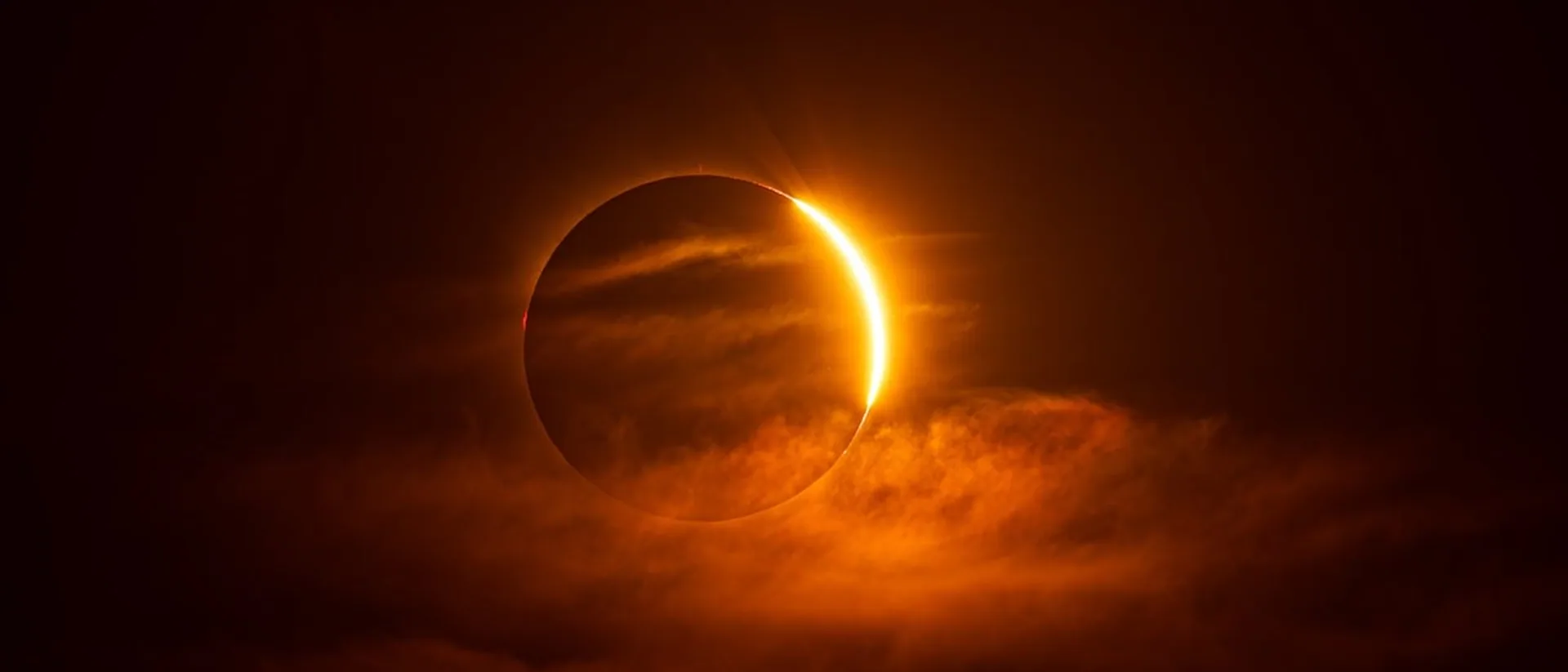
- The diamond ring: In the final seconds before totality, the last bright point of sunlight at the Moon's edge creates a brilliant flare, the diamond ring effect. A thin, bright ring of the Sun's photosphere may still be visible, with one spot dramatically brighter than the rest.
Totality Itself
When the Moon fully covers the Sun, the transformation is instantaneous and overwhelming:
- The solar corona: The Sun's outer atmosphere appears as a pearly white halo surrounding the black disk of the Moon. Streamers extend outward, longest at the Sun's equator and shorter at the poles. The corona's shape changes with the solar cycle, near solar maximum (expected around 2025–2026), the corona tends to be more symmetrical with streamers in all directions; near solar minimum, it is more elongated at the equator.
- Chromosphere and prominences: Along the Moon's edge, you may see bright pinkish-red patches, these are solar prominences, arcs of plasma anchored to the Sun's surface. They can extend tens of thousands of kilometers into space and are often visible during totality.
- The sky darkens: The sky near the Sun becomes dark enough to see the brightest stars and planets. Venus is usually prominent, and Jupiter, Mercury, and bright stars like Regulus may also be visible depending on their positions.
- The 360-degree sunset: The horizon in all directions glows with sunset colors, because you are standing in the Moon's shadow while areas beyond the shadow are still in sunlight. This is one of the most surreal aspects of totality.
- Silence and awe: Many observers report that the crowd falls silent during totality, followed by gasps, applause, and sometimes tears. It is an intensely emotional experience that is difficult to convey to someone who has not witnessed it.
The End of Totality
Totality ends with a second diamond ring, the moment when the first ray of sunlight emerges from behind the Moon's opposite edge. This is your signal to immediately put your eclipse glasses back on. The return of sunlight after the deep darkness of totality is almost shocking in its intensity.
How to Safely View This Eclipse
Eye safety is the single most important consideration when viewing a solar eclipse. The Sun's radiation can cause permanent retinal damage in seconds, and this damage may not be immediately noticeable because the retina has no pain receptors.
Certified Eclipse Glasses
Use only eclipse glasses that comply with the ISO 12312-2 international safety standard. These filters reduce the Sun's intensity by a factor of at least 100,000, making it safe to look at the Sun directly.
How to verify your eclipse glasses:
- Look for the ISO 12312-2 certification printed on the glasses
- When wearing them, you should see nothing except the Sun (or something equally bright, like a bright halogen lamp)
- If you can see ordinary objects through the glasses, they are not safe
- Purchase from reputable vendors, the American Astronomical Society maintains a list of approved suppliers
- Inspect glasses for scratches, punctures, or tears before use, damaged glasses are not safe
Safe Indirect Viewing Methods
If you do not have eclipse glasses, you can safely view the eclipse using indirect projection methods:
Pinhole Projector: Poke a small hole (1–2mm) in a piece of cardboard. Hold the cardboard up to the Sun with a second surface (white paper, wall, or ground) behind it. An image of the eclipsed Sun will be projected onto the second surface. The farther the cardboard is from the projection surface, the larger (but dimmer) the image will be.
Colander Method: Hold a kitchen colander up to the Sun and look at the ground beneath it. Each hole projects a small image of the crescent Sun, a beautiful and easy way to see the eclipse without any special equipment.
Telescope Projection: A telescope or binoculars can project a large, detailed image of the Sun onto a white card. However, this must be done carefully, the concentrated sunlight can damage the optics and start fires. Never look through the eyepiece without a proper solar filter.
What NOT to Do
| Dangerous Practice | Why It's Dangerous |
|---|---|
| Looking through sunglasses | Sunglasses block visible light but not infrared/UV radiation |
| Using smoked glass | Uneven filtering; can crack from heat |
| Looking through CDs/DVDs | Inconsistent filtering; not designed for solar viewing |
| Using exposed film | Modern film does not provide adequate protection |
| Looking through water reflections | Water does not block enough radiation |
| Using binoculars/telescope without a front-aperture solar filter | Concentrated sunlight will cause instant, severe eye damage |
| Using eyepiece solar filters | These can crack from concentrated heat, use front-aperture filters only |
During Totality: The Safe Window
During the period of totality, and only during totality, it is safe to view the eclipse with the naked eye, binoculars, or a telescope without solar filters. However, you must be absolutely certain that totality has begun before removing your eye protection, and you must replace it the instant sunlight reappears. The diamond ring at the end of totality is your warning signal: filters on immediately.
If you are near the edge of the path of totality, totality may be very brief (seconds rather than minutes). Be extra cautious in these locations, as the window for safe unfiltered viewing is extremely short.
Photography Guide for the Total Solar Eclipse
Photographing a total solar eclipse is challenging but immensely rewarding. The extreme dynamic range, from the faint corona to the brilliant diamond ring, means no single exposure can capture the entire event. Here is a comprehensive guide.
Essential Equipment
| Equipment | Recommendation |
|---|---|
| Camera body | DSLR or mirrorless with manual mode and RAW capability |
| Lens | 300–600mm for the eclipsed Sun; wider for landscape shots |
| Solar filter | Must fit your lens; certified to ISO 12312-2 |
| Tripod | Sturdy, essential for sharp images |
| Remote shutter release | Prevents camera shake |
| Extra batteries | Cold temperatures and long sessions drain batteries quickly |
| Memory cards | Bring more than you think you need |
Exposure Settings
| Eclipse Phase | ISO | Aperture | Shutter Speed | Filter? |
|---|---|---|---|---|
| Partial eclipse (Sun visible) | 100 | f/8 | 1/500–1/1000s | YES |
| Diamond ring (seconds before/after totality) | 100 | f/8 | 1/1000–1/4000s | Remove JUST as totality begins |
| Inner corona | 200 | f/5.6 | 1/125–1/500s | No |
| Outer corona | 800 | f/4 | 1/15–1/60s | No |
| Prominences | 200 | f/8 | 1/250–1/1000s | No |
| Totality wide-angle (landscape) | 400–800 | f/4–f/5.6 | 1–4s (on tripod) | No |
Photography Strategy
Practice beforehand: Set up your equipment and practice your workflow at least once before eclipse day. Know exactly how to remove and replace your solar filter quickly. The two minutes of totality will pass faster than you can imagine.
Use exposure bracketing: The corona has an enormous dynamic range. Take multiple exposures at different settings during totality to capture everything from the bright inner corona to the faint outer streamers.
Consider a solar eclipse sequence: Mount your camera on a tripod with a solar filter and take one photo every 2–5 minutes from first contact through fourth contact. In post-processing, you can create a composite showing the entire sequence of the eclipse.
Do not forget to look: Many first-time eclipse photographers spend totality fiddling with camera settings and miss the actual experience. Plan your photography in advance, set up a simple sequence, and make sure you spend at least 30 seconds simply looking at the eclipse with your own eyes.
Why This Eclipse Is Historically Significant
The August 12, 2026 total solar eclipse holds particular significance for several regions that have waited decades, or even centuries, for totality.
Iceland: A Once-in-Centuries Event
The last total solar eclipse visible from Iceland occurred on June 30, 1954. The next one will not occur until June 28, 2196, more than 170 years after the 2026 eclipse. This makes the August 2026 event a genuine once-in-a-lifetime opportunity for Iceland's population and visitors. Iceland's entire landmass falls within the path of totality, meaning every resident and tourist on the island can experience the full eclipse without traveling to a specific location within the country.
Spain: First Totality Since 1905
The last total solar eclipse whose path crossed mainland Spain occurred on August 30, 1905, when totality swept from Burgos through Catalonia and scientific expeditions, including the U.S. Naval Observatory, set up across the country. A hybrid eclipse followed on April 17, 1912, but it delivered totality only for a few seconds along a one-kilometre-wide sliver through Galicia and Asturias. The 2026 eclipse therefore ends a 121-year drought of real totality for Spanish observers. The path crosses some of Spain's most beautiful northern regions, and Spanish authorities are already preparing for a significant influx of eclipse tourists.
Europe: First Since 1999
For Europe as a whole, the August 2026 eclipse is the first total solar eclipse to cross continental Europe since the famous August 11, 1999 eclipse that ran from Cornwall to the Black Sea. (The March 20, 2015 eclipse touched only the Faroe Islands and Svalbard, European soil, but not mainland Europe.) The 1999 eclipse was witnessed by hundreds of millions of people and sparked a lasting interest in eclipse chasing across the continent. The 27-year gap between the 1999 and 2026 eclipses has built enormous anticipation, and the 2026 event is expected to draw record crowds to Iceland and northern Spain.
Partial Eclipse Viewing Guide
For the vast majority of observers, the August 12, 2026 eclipse will be a partial event. While not as dramatic as totality, a deep partial eclipse is still a compelling sight, especially with coverage exceeding 80–90% in many European cities.
What a Partial Eclipse Looks Like
During a partial eclipse, the Moon appears to take a progressively larger "bite" out of the Sun. The Sun's shape shifts from a circle to a crescent. Even at 90% coverage, the remaining 10% of the Sun is still extremely bright, far too bright to look at without protection. The sky may dim slightly, and shadows may appear sharper, but the dramatic darkening and corona visible during totality will not occur.
Partial Eclipse Coverage for Major Cities
| City | Approximate Coverage | Partial Begins | Maximum | Partial Ends |
|---|---|---|---|---|
| London, UK | ~93% | 18:17 BST | 19:13 BST | 20:06 BST |
| Paris, France | ~93% | 19:22 CEST | 20:17 CEST | 21:09 CEST |
| Berlin, Germany | ~87% | 19:15 CEST | 20:08 CEST | 20:58 CEST |
| Madrid, Spain | ~99.9% | 19:36 CEST | 20:32 CEST | 21:24 CEST |
| Rome, Italy | ~96% | 19:32 CEST | 20:24 CEST | 21:13 CEST |
| Amsterdam, Netherlands | ~90% | 19:16 CEST | 20:11 CEST | 21:03 CEST |
| Oslo, Norway | ~86% | 19:02 CEST | 19:57 CEST | 20:49 CEST |
| Stockholm, Sweden | ~84% | 19:03 CEST | 19:56 CEST | 20:47 CEST |
| Helsinki, Finland | ~83% | 19:00 EEST | 19:52 EEST | 20:42 EEST |
| Lisbon, Portugal | ~95% | 18:39 WEST | 19:36 WEST | 20:29 WEST |
| Moscow, Russia | ~84% | 20:03 MSK | 20:53 MSK | 21:41 MSK |
| Casablanca, Morocco | ~89% | 18:48 WEST | 19:44 WEST | 20:35 WEST |
Tips for Partial Eclipse Viewing
-
Always use eclipse glasses: There is no safe moment to look at the Sun with the naked eye during a partial eclipse. Keep your ISO 12312-2 certified glasses on at all times.
-
Try the colander trick: Hold a kitchen colander above a white surface to project dozens of crescent Sun images, a fun and safe group activity.
-
Look for crescent shadows: Sunlight filtering through tree leaves creates natural pinhole projectors, casting thousands of crescent-shaped shadows on the ground.
-
Watch the light quality change: Even at 80% coverage, you may notice the light becoming strangely metallic and shadows becoming unusually sharp.
-
Photograph with a solar filter: Use the same solar filter techniques as for the total eclipse, adjusting exposure for the bright crescent Sun.
Planning Your Trip to See Totality
If you are planning to travel for the August 2026 total solar eclipse, early preparation is essential. Accommodations and transportation in the path of totality, particularly in Iceland and northern Spain, will be heavily booked.
Iceland
Pros: Entire country in the path; dramatic scenery; good infrastructure; English widely spoken
Cons: Unpredictable weather in August; limited accommodation; expensive; roads can be challenging
Planning tips:
- Book accommodations 12–18 months in advance, hotels in Reykjavik and along the Ring Road will sell out
- Rent a car for mobility, being able to drive to clear skies on eclipse day is invaluable
- Have a Plan B and Plan C viewing location, check cloud forecasts starting 48 hours before the eclipse
- Pack warm layers, even in August, Icelandic weather can change rapidly
Northern Spain
Pros: Better weather prospects than Iceland; excellent infrastructure; rich cultural attractions; affordable compared to Iceland
Cons: Totality is shorter (~1–1.5 minutes vs ~2 minutes in Iceland); Sun lower on the horizon (~20° altitude); path is relatively narrow
Planning tips:
- Base yourself in Gijón, Oviedo, or another city within the path
- Book early, northern Spain is a popular vacation destination in August
- The eclipse occurs in the evening (~19:30 CEST), so plan for a sunset-time eclipse
- Be aware of the potential for afternoon thunderstorms in interior locations
Greenland
Pros: Longest totality; stunning Arctic scenery; minimal light pollution
Cons: Extremely limited access; no regular commercial flights to the path; very expensive; uncertain weather
Planning tips:
- Expedition cruise companies are already planning eclipse voyages to Scoresby Sund
- Book at least a year in advance; these trips fill quickly
- Prepare for extreme weather variability and cold temperatures
- Consider this only if you are an experienced Arctic traveler
Future Total Solar Eclipses
If you miss the August 2026 eclipse, or if you catch the bug and want more, here are the upcoming total solar eclipses over the next decade:
| Date | Path of Totality | Maximum Duration | Notable Locations |
|---|---|---|---|
| Aug 12, 2026 | Arctic, Greenland, Iceland, N Spain | 2m 18s | Reykjavik, Gijón |
| Aug 2, 2027 | N Africa, Middle East, S Asia | 6m 23s | Luxor, Mecca, Gujarat |
| Jul 22, 2028 | SE Asia, Australia, New Zealand | 5m 10s | Sydney, Queenstown |
| Nov 3, 2031 | Central Africa, Indian Ocean | 1m 02s | Remote ocean crossing |
| Mar 30, 2033 | Alaska, Arctic | 2m 37s | Utqiagvik (Barrow) |
| Sep 2, 2035 | China, Korea, Japan, Pacific | 2m 54s | Beijing, Tokyo |
| Jul 13, 2037 | Australia, New Zealand, Pacific | 3m 58s | Brisbane, Auckland |
| Dec 26, 2038 | Australia, New Zealand, Pacific | 2m 18s | Melbourne, Wellington |
The August 2, 2027 total solar eclipse is particularly noteworthy, with over 6 minutes of totality, it will be one of the longest total eclipses of the 21st century. The path crosses Egypt, making the Pyramids of Giza and the temples of Luxor potential viewing sites. This eclipse is already generating enormous interest in the eclipse tourism community.
More 2026 Astronomy Events
Perseid Meteor Shower 2026
100 meteors per hour on moon-free nights, the best Perseids until 2028.
Read moreWhen Is the Next Solar Eclipse?
All upcoming solar eclipses through 2030, with paths of totality.
Read moreAugust 28 Partial Lunar Eclipse
Two weeks after the solar eclipse, a partial lunar eclipse visible across the Americas.
Read moreWhen Is the Next Lunar Eclipse?
Upcoming lunar eclipses and visibility maps.
Read moreMoon Phases 2026
Full moon dates, new moon dates, and supermoons for the year.
Read moreMeteor Showers 2026
All major meteor showers in 2026, with peak dates and viewing tips.
Read moreDon't Miss Tonight: Perseid Meteor Shower
August 12 isn't just eclipse day, it's also the peak of the Perseid meteor shower. With the New Moon just one day prior, 2026 offers the best Perseid viewing conditions until 2028. Expect up to 100 meteors per hour in dark skies.
Perseid Meteor Shower 2026: Complete Viewing GuideFrequently Asked Questions
12 questions answered
What time is the total solar eclipse on August 12, 2026?
Where is the best place to see the August 2026 total solar eclipse?
How long will totality last?
Is it safe to look at the total solar eclipse without glasses?
Will this eclipse be visible from the United States?
What is the solar corona?
Why does the temperature drop during a total solar eclipse?
What are Baily's beads?
Can I photograph the eclipse with my phone?
How is this eclipse different from the 2024 total solar eclipse?
When is the next total solar eclipse after August 2026?
What are shadow bands?
Put this into action
Stop guessing. Use our professional tools to schedule, convert, and manage time zones perfectly, 100% free.
Track Sky EventsOfficial Sources & References
- NASA Science: official data and scientific overviews for astronomical events and missions.