When Is the Next Lunar Eclipse?

Quick Answer
The next lunar eclipse is a subtle penumbral eclipse on February 20, 2027, visible from Africa, Europe, and Asia, the Moon only grazes Earth's outer shadow, so expect a faint dimming rather than a dramatic show. The next umbral eclipse (where the Moon visibly turns red) is a deep partial on the night of July 6, 2028. And the eclipse most people are still talking about, the August 27–28, 2026 deep partial over the Americas, is covered below. No special equipment is ever needed: just look up.
What Is a Lunar Eclipse?
A lunar eclipse occurs when the Earth moves directly between the Sun and the Moon, casting its shadow onto the lunar surface. This can only happen during a full moon, when the Moon is on the opposite side of Earth from the Sun. However, lunar eclipses do not occur every full moon because the Moon's orbital plane is tilted about 5 degrees relative to Earth's orbital plane around the Sun. Only when the Moon is near one of its orbital nodes, the points where the Moon's path crosses the ecliptic plane, can an eclipse take place.
Understanding Earth's Shadow: Umbra and Penumbra
Earth casts two distinct shadow regions in space:
- Penumbra: The outer, lighter shadow where the Sun is only partially blocked by Earth. When the Moon passes through the penumbra, it dims slightly, but the effect is often too subtle for casual observers to notice.
- Umbra: The inner, dark shadow where the Sun is completely blocked by Earth. When the Moon enters the umbra, a noticeable darkening occurs, and during a total lunar eclipse, the Moon can take on a dramatic red or copper color.
The distance between Earth and the Moon affects whether the Moon fully enters the umbra. At perigee (closest approach), the Moon appears larger and is more likely to be completely immersed in the umbra. At apogee (farthest distance), the Moon appears smaller and may only partially enter the umbra. Whether an eclipse is total or partial ultimately comes down to this geometry, and on August 27–28, 2026, the Moon's path carried it just short of full immersion, producing a deep partial eclipse.
Types of Lunar Eclipses
| Type | Description | Visual Effect |
|---|---|---|
| Total | Moon passes entirely into Earth's umbral shadow | Deep red or copper "Blood Moon" |
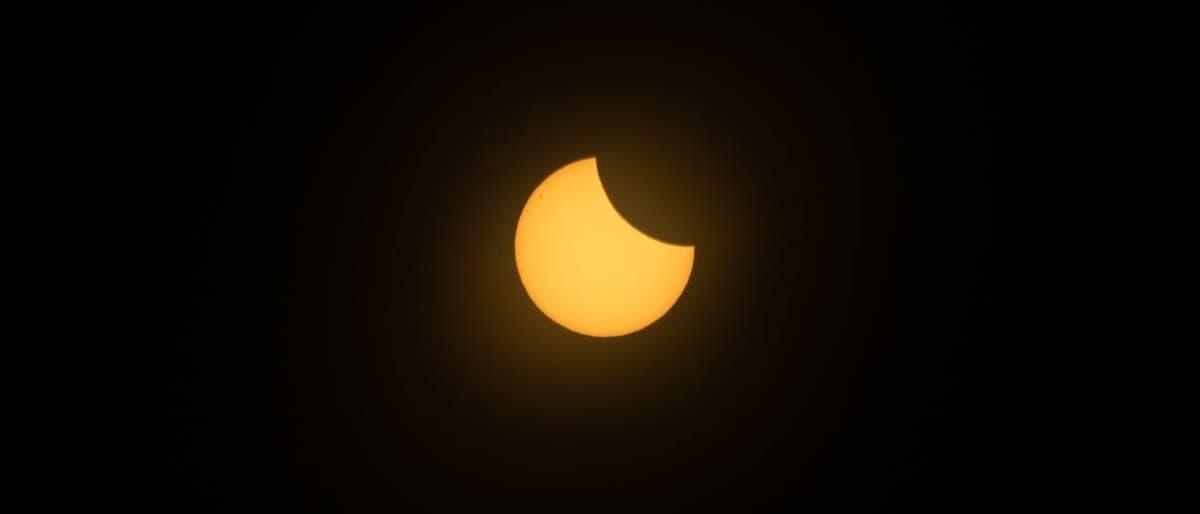
| Partial | Only part of the Moon enters the umbral shadow | A dark "bite" appears on one side of the Moon |
| Penumbral | Moon passes only through Earth's penumbral shadow | Subtle dimming, often hard to detect |
The Most Recent Umbral Eclipse: August 27–28, 2026
The night of August 27–28, 2026 delivered the deepest partial lunar eclipse since November 2021: at maximum, 93.2% of the Moon's diameter sat inside Earth's umbral shadow (umbral magnitude 0.932). The Americas had the entire show, the Moon rode high while the shadow's bite crossed nearly the whole disk, with western Europe and West Africa catching the phases before dawn. The eclipsed portion glowed deep red, with a thin bright sliver persisting along the Moon's northern edge.
Exact Timing in UTC
| Phase | UTC Time |
|---|---|
| P1, Penumbral eclipse begins | August 28, 2026, 01:23 UTC |
| U1, Partial eclipse begins (umbral contact) | August 28, 2026, 02:33 UTC |
| Greatest eclipse (maximum) | August 28, 2026, 04:13 UTC |
| U4, Partial eclipse ends (umbral exit) | August 28, 2026, 05:52 UTC |
| P4, Penumbral eclipse ends | August 28, 2026, 07:02 UTC |
Duration of umbral (partial) phase: 3 hours 19 minutes
Duration of entire eclipse (penumbral to penumbral): 5 hours 39 minutes
Key Eclipse Parameters
| Parameter | Value |
|---|---|
| Eclipse type | Partial lunar eclipse |
| Saros series | 138 |
| Umbral magnitude | 0.932 |
| Penumbral magnitude | 1.966 |
Timing Table for Major Cities
Because the eclipse unfolded overnight across the Americas and before dawn over the Eastern Hemisphere, local viewing times varied widely. All times below are converted from the verified UTC contacts: umbral first contact 02:33, maximum 04:13, umbral last contact 05:52 UTC on August 28.
| City | Time Zone | Partial Begins (U1) | Maximum Eclipse | Partial Ends (U4) | Visibility |
|---|---|---|---|---|---|
| New York, USA | EDT (UTC−4) | Aug 27, 22:33 | Aug 28, 00:13 | Aug 28, 01:52 | Entire eclipse, Moon high in SSW |
| Chicago, USA | CDT (UTC−5) | Aug 27, 21:33 | Aug 27, 23:13 | Aug 28, 00:52 | Entire eclipse |
| Denver, USA | MDT (UTC−6) | Aug 27, 20:33 | Aug 27, 22:13 | Aug 27, 23:52 | Entire eclipse |
| Los Angeles, USA | PDT (UTC−7) | Aug 27, 19:33 | Aug 27, 21:13 | Aug 27, 22:52 | Entire eclipse, prime evening |
| Mexico City, Mexico | CST (UTC−6) | Aug 27, 20:33 | Aug 27, 22:13 | Aug 27, 23:52 | Entire eclipse |
| São Paulo, Brazil | BRT (UTC−3) | Aug 27, 23:33 | Aug 28, 01:13 | Aug 28, 02:52 | Entire eclipse |
| London, UK | BST (UTC+1) | Aug 28, 01:33 | Aug 28, 03:13 | Aug 28, 04:52 | Pre-dawn, Moon low in WSW |
| Paris, France | CEST (UTC+2) | Aug 28, 02:33 | Aug 28, 04:13 | Aug 28, 05:52 | Pre-dawn, Moon very low |
| Lagos, Nigeria | WAT (UTC+1) | Aug 28, 01:33 | Aug 28, 03:13 | Aug 28, 04:52 | Pre-dawn, Moon low in W |
| Cairo, Egypt | EEST (UTC+3) | Aug 28, 03:33 | Aug 28, 05:13 | Aug 28, 06:52 | Moon sets near maximum |
| Dubai, UAE | GST (UTC+4) | Aug 28, 04:33 | Aug 28, 06:13 | Aug 28, 07:52 | Not visible (daylight) |
| Mumbai, India | IST (UTC+5:30) | Aug 28, 05:03 | Aug 28, 06:43 | Aug 28, 08:22 | Not visible (daylight) |
| Beijing, China | CST (UTC+8) | Aug 28, 08:33 | Aug 28, 10:13 | Aug 28, 11:52 | Not visible (daylight) |
| Tokyo, Japan | JST (UTC+9) | Aug 28, 09:33 | Aug 28, 11:13 | Aug 28, 12:52 | Not visible (daylight) |
| Sydney, Australia | AEST (UTC+10) | Aug 28, 10:33 | Aug 28, 12:13 | Aug 28, 13:52 | Not visible (daylight) |
| Nairobi, Kenya | EAT (UTC+3) | Aug 28, 05:33 | , (Moon sets during eclipse) | Moon sets ~06:28 EAT, low in the west, partway through the umbral phase |
Note: Times are converted from the UTC contact times and may vary by a minute or two with exact location. The eclipse belonged to the Americas, the Moon was up for the entire umbral phase from New York to Los Angeles, while Asia and Australia were on the daylight side of the planet.
Who Can See It?
The August 27–28, 2026 partial lunar eclipse will be visible across a large portion of the Eastern Hemisphere. Because the Moon will be above the horizon during the eclipse for much of this region, hundreds of millions of people will have the opportunity to witness it.
Visibility by Region
| Region | Visibility | Notes |
|---|---|---|
| North America | Excellent | Entire umbral phase; Moon high, prime late-evening viewing |
| South America | Excellent | Entire umbral phase visible overnight |
| Hawaii & eastern Pacific | Good | Whole event visible high in the sky |
| Western Europe | Good | Umbral phase before dawn; Moon descending in WSW |
| West Africa | Good | Pre-dawn viewing, Moon low in the west |
| Central/Eastern Europe | Partial | Early umbral phases only; Moon very low |
| Middle East & South Asia | Not visible | Moon below horizon / daylight |
| East Asia & Australia | Not visible | Eclipse occurs in daytime |
The broad reach of lunar eclipses is one of their advantages over solar ones: while a total solar eclipse is visible only from a strip of land roughly 100–200 km wide, a lunar eclipse is visible from the entire night side of Earth, and on this night, that night side was centered on the Americas.
Lunar vs Solar Eclipse: What's the Difference?
Many people confuse lunar and solar eclipses or assume they are similar events. While both involve the alignment of the Sun, Earth, and Moon, the mechanics are different and so is what an observer sees.
| Feature | Lunar Eclipse | Solar Eclipse |
|---|---|---|
| Alignment | Earth between Sun and Moon | Moon between Sun and Earth |
| Occurs during | Full Moon | New Moon |
| What is shadowed | The Moon | The Earth's surface |
| Visibility | Entire night side of Earth | Only within a narrow path |
| Safety | Completely safe to view with naked eye | Requires eye protection (except during totality) |
| Color change | Moon turns red/copper | Daylight turns to twilight briefly |
| Duration | Several hours | Totality lasts minutes; full event a few hours |
| Frequency | 2–5 per year (all types) | 2–5 per year (all types) |
The most important practical difference is safety. You can watch a lunar eclipse with your bare eyes, binoculars, or a telescope without any filters. A solar eclipse, on the other hand, requires certified eye protection at all times except during the brief moments of total totality.
How to Watch a Lunar Eclipse
One of the best things about a lunar eclipse is that it requires no special equipment, no travel to a specific location, and no eye protection. If the Moon is above your horizon and the sky is reasonably clear, you can see it.
What You Need
- Your eyes: That is genuinely all you need. The Moon is bright enough that even from light-polluted cities, a lunar eclipse is clearly visible.
- Binoculars (optional): A pair of 7×50 or 10×50 binoculars will enhance the view, letting you see the color gradient across the Moon's face as Earth's shadow advances.
- A small telescope (optional): Even a modest 60–80mm refractor will reveal stunning detail, including the sharp edge of Earth's umbra and the subtle color variations in the eclipsed portion.
Viewing Tips
-
Find a clear view of the sky: Unlike solar eclipses, you do not need an unobstructed view of the horizon. The Moon will be high in the sky for most viewers in Europe, Africa, and western Asia.
-
Allow your eyes to adapt: Give yourself 15–20 minutes in darkness before the eclipse begins so your eyes are fully adapted. This will help you appreciate the subtle penumbral shading.
-
Watch the entire sequence: The real magic of a lunar eclipse is watching the shadow creep across the Moon over the course of hours. Arrive early for the penumbral phase and stay through the end.
-
Dress warmly: Even in August, nighttime temperatures can drop significantly, especially if you are standing still for hours. Bring layers.
-
Check the weather: Cloud cover is the only thing that can ruin a lunar eclipse viewing. Check your local forecast 1–2 days in advance.
Photographing a Lunar Eclipse
Lunar eclipse photography is accessible even for beginners. Here are some guidelines:
- Use a tripod: Essential for sharp images, especially during the darker phases.
- DSLR or mirrorless camera: Use the longest lens you have. A 200mm lens will capture a reasonable Moon; 400mm or longer is ideal.
- Settings for the bright partial phase: ISO 200, f/8, 1/250 second
- Settings for maximum eclipse: ISO 800, f/5.6, 1–2 seconds (the eclipsed Moon is much dimmer)
- Bracket your exposures: The brightness changes dramatically throughout the eclipse, so take shots at multiple exposure settings.
- Shoot in RAW: This gives you the most flexibility in post-processing, especially for pulling out the subtle reds and oranges.
- Consider a composite image: Many photographers create stunning composites showing the Moon at different phases of the eclipse in a single frame.
Upcoming Lunar Eclipses Through 2028
The August 2026 eclipse has passed, but there are several more opportunities coming up. Here is the complete list of lunar eclipses through 2028, with their types and visibility regions.
| Date | Type | Magnitude | Visibility |
|---|---|---|---|
| Aug 27–28, 2026 | Partial | 0.932 | Americas, western Europe, West Africa |
| Feb 20–21, 2027 | Penumbral | , (0.929 penumbral) | Africa, Europe, Asia |
| Aug 17–18, 2027 | Penumbral | , (0.546 penumbral) | Europe, Africa, Asia, Australia |
| Jan 12, 2028 | Partial | 0.068 | Americas, Europe, Africa |
| Jul 6–7, 2028 | Partial | 0.391 | Africa, Asia, Australia |
| Dec 31, 2028 – Jan 1, 2029 | Total | 1.248 | E Europe, Asia, Australia |
Notably, there is no total lunar eclipse until December 31, 2028, a New Year's Eve Blood Moon (umbral magnitude 1.248) best seen from eastern Europe, Asia, and Australia, rising over Africa and Europe. The two 2027 penumbral eclipses will be visually subtle, and the two 2028 partials are shallow, so for viewers in the Americas, the August 2026 deep partial they saw in prime time is the most dramatic umbral eclipse of this stretch.
Why Lunar Eclipses Are Easier to See Than Solar Ones
If you have ever chased a total solar eclipse, you know it requires traveling to a specific location, often at great expense, and even then, clouds can ruin everything. Lunar eclipses are far more forgiving for several important reasons:
-
Half the planet can see them: Any location where the Moon is above the horizon during the eclipse can see it. That means an entire hemisphere enjoys the show, not just a narrow strip.
-
No eye protection needed: You can look directly at a lunar eclipse, share binoculars with friends, and take photos without special solar filters.
-
They last for hours: A solar eclipse's totality may last only 2–3 minutes, but a lunar eclipse's partial phase stretches over two hours or more. You have plenty of time to watch, photograph, and enjoy it.
-
Predictable timing: The Moon is always full during a lunar eclipse, so you know exactly when and where to look. No need to find an obscure location along a path of totality.
-
More frequent at any given location: Because they are visible from half the Earth, a given location sees lunar eclipses more often than solar ones. On average, any spot on Earth sees a total lunar eclipse every 2–3 years, compared to every 375 years for a total solar eclipse.
The trade-off is that lunar eclipses are less dramatic than total solar eclipses. There is no sudden darkness, no corona, and no diamond ring effect. But for casual observers and those who want a reliable, low-effort celestial experience, a lunar eclipse, especially one as deep as the August 2026 event, is hard to beat.
Frequently Asked Questions
10 questions answered
When is the next lunar eclipse?
Was the August 2026 lunar eclipse visible from the United States?
Is it safe to look at a lunar eclipse with the naked eye?
Why does the Moon turn red during a lunar eclipse?
How often do lunar eclipses happen?
What was the magnitude of the August 2026 partial lunar eclipse?
Do I need a telescope to see a lunar eclipse?
What is the difference between a partial and a total lunar eclipse?
When is the next total lunar eclipse?
Can I photograph a lunar eclipse with my phone?
Put this into action
Stop guessing. Use our professional tools to schedule, convert, and manage time zones perfectly, 100% free.
Track Sky EventsOfficial Sources & References
- NASA Science: official data and scientific overviews for astronomical events and missions.