February 6, 2027 Annular Solar Eclipse

Quick Answer
An annular solar eclipse will occur on February 6, 2027, creating a spectacular "Ring of Fire" as the Moon passes in front of the Sun but is too far from Earth to completely cover it. The path of annularity crosses South America, the Atlantic Ocean, and western and central Africa. Unlike a total solar eclipse, there is never a safe moment to look at an annular eclipse without certified eye protection.
Quick Answer
The next annular solar eclipse occurs on February 6, 2027, and will be visible as a "Ring of Fire" from parts of Argentina, Chile, the Atlantic Ocean, and across Africa from Angola to Kenya. Outside the annular path, a partial eclipse will be visible across much of South America, Africa, and southern Europe. Maximum annularity lasts 7 minutes 51 seconds over the Atlantic Ocean, one of the longest annular durations of the 21st century.
What Is an Annular Solar Eclipse?
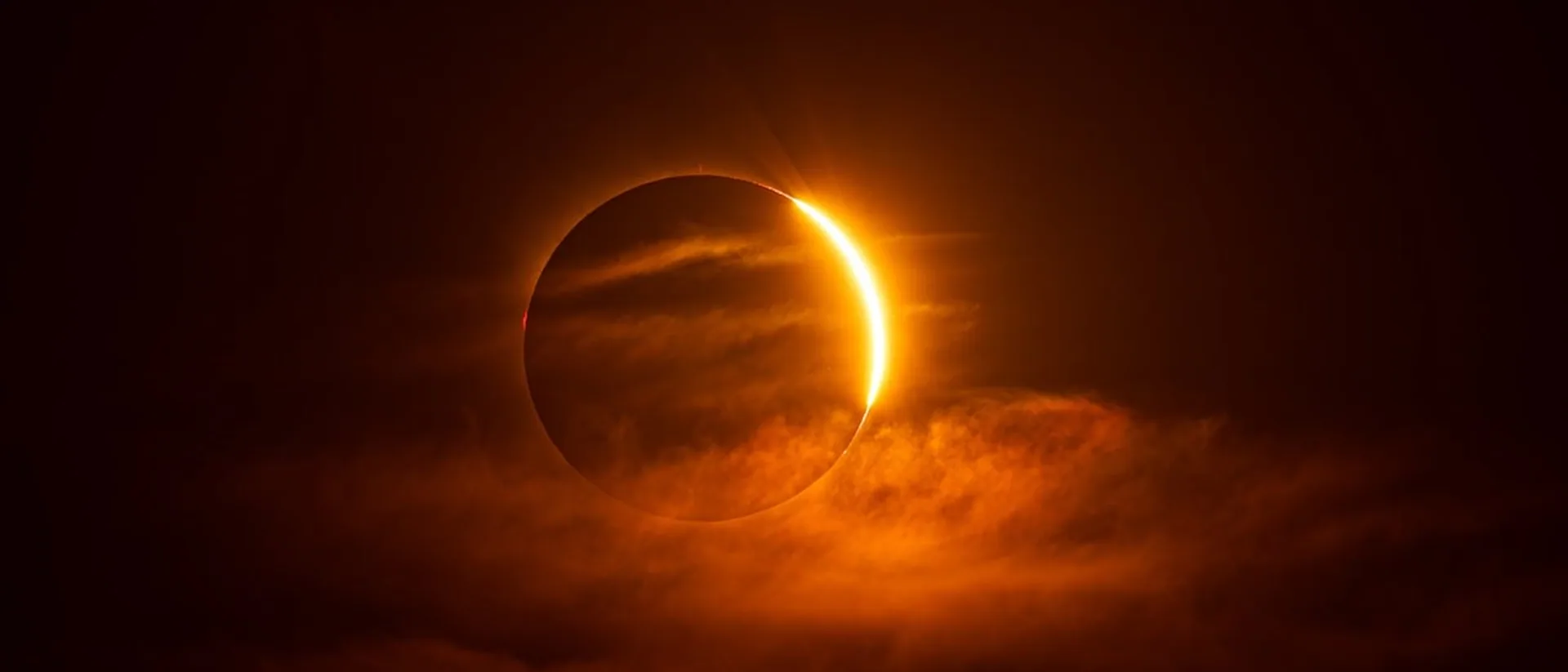
An annular solar eclipse occurs when the Moon passes directly between the Sun and Earth but is too far from Earth (near apogee, its farthest point) to completely cover the Sun's disk. Because the Moon appears slightly smaller than the Sun, a bright ring of sunlight remains visible around the Moon's silhouette, this is the famous "Ring of Fire."
The word "annular" comes from the Latin word annulus, meaning "ring." Despite the dramatic name, an annular eclipse never reaches totality. Even at maximum eclipse, the blinding ring of sunlight remains visible, so the event differs from a total solar eclipse in both visual experience and safety requirements.
Why the Moon Sometimes Appears Too Small
The Moon's orbit around Earth is elliptical, not circular. This means the Moon's distance from Earth varies by roughly 50,000 kilometers throughout each orbit:
- Perigee (closest): ~356,500 km, the Moon appears about 11% larger than average
- Apogee (farthest): ~406,700 km, the Moon appears about 10% smaller than average
At perigee, the Moon's apparent angular diameter exceeds the Sun's (~0.548° vs ~0.530°), allowing it to fully cover the Sun and produce a total eclipse. At apogee, the Moon appears smaller than the Sun (~0.490° vs ~0.530°), and even when perfectly aligned, a ring of sunlight remains, producing an annular eclipse.
The February 2027 eclipse occurs when the Moon is just 3.5 days past apogee, meaning it appears significantly smaller than the Sun. The result is a wide, brilliant Ring of Fire rather than the complete coverage of a total eclipse.
Annular vs Total: The Critical Safety Difference
This distinction cannot be emphasized enough: during an annular eclipse, there is never a moment when it is safe to look at the Sun without certified eye protection. The Ring of Fire, while visually stunning, is still direct sunlight, it is just as dangerous to your eyes as looking at the uneclipsed Sun. This is the opposite of a total solar eclipse, where the brief period of totality allows safe naked-eye viewing.
| Safety Aspect | Total Solar Eclipse | Annular Solar Eclipse |
|---|---|---|
| Safe without filters? | Only during totality | Never |
| Brightest element | Corona during totality (safe) | Ring of Fire (dangerous) |
| Eye damage risk during peak | None (during totality) | Severe and immediate |
The Path of the February 6, 2027 Eclipse
The path of annularity for the February 6, 2027 eclipse stretches over 13,000 kilometers, beginning in the South Pacific Ocean and ending in the Indian Ocean off the coast of East Africa. Along this narrow strip, roughly 180–280 km wide, observers will see the complete Ring of Fire.
Detailed Path Description
South Pacific Ocean: The Moon's antumbral shadow first touches Earth at sunrise over the South Pacific, roughly 1,500 km west of the Chilean coast. This is an extremely remote ocean region with no land in the path.
South America (13:30–14:15 UTC): The path makes landfall in southern Chile and Argentina, crossing the Argentine provinces of Neuquén, Río Negro, and Buenos Aires Province. Key cities within or near the path include:
- Neuquén, Argentina, near the center line
- General Roca, Argentina, within the path
- Bahía Blanca, Argentina, near the path
- The path then exits South America near the Río de la Plata estuary
The South American segment offers excellent weather prospects for February, with summer conditions and a good chance of clear skies in the Argentine steppe and Patagonian regions.
Atlantic Ocean (14:15–16:00 UTC): The shadow crosses the South Atlantic Ocean in a long arc. This is the segment with the longest annularity, up to 7 minutes 51 seconds, occurring over open water. Cruise ships may position themselves along the path.
Africa (16:00–17:00 UTC): The path enters Africa along the coast of Angola and sweeps east-southeast across the continent, crossing:
- Angola, Luanda is near the path; the center line passes through central Angola
- Democratic Republic of the Congo, southern DRC, including Lubumbashi area
- Tanzania, the path crosses central Tanzania
- Kenya, the path exits Africa through southern Kenya, near the Tanzanian border
The African segment offers diverse viewing conditions, from the semi-arid coast of Angola to the highlands of Tanzania. February is typically the dry season in East Africa, suggesting good weather prospects for the Tanzania-Kenya section.
Indian Ocean: The shadow leaves Earth's surface over the Indian Ocean at approximately 17:01 UTC.
Key Locations Along the Path
| Location | Country | Annularity Duration | Sun Altitude | Weather Outlook |
|---|---|---|---|---|
| Neuquén | Argentina | ~6m 30s | ~60° | Good (summer, dry) |
| General Roca | Argentina | ~6m 45s | ~58° | Good |
| Bahía Blanca | Argentina | ~6m 00s | ~55° | Moderate (coastal) |
| Luanda | Angola | ~7m 00s | ~60° | Moderate (coastal) |
| Lubumbashi | DRC | ~7m 15s | ~68° | Moderate |
| Dodoma | Tanzania | ~7m 30s | ~65° | Good (dry season) |
| Arusha | Tanzania | ~7m 10s | ~60° | Good (dry season) |
| Mombasa | Kenya | ~5m 30s | ~30° | Moderate |
Exact Timing by Location
The following table provides approximate local times for the key phases of the eclipse, first contact (C1, partial begins), second contact (C2, annularity begins), maximum eclipse, third contact (C3, annularity ends), and fourth contact (C4, partial ends).
| Location | C1 | C2 (Ring Begins) | Maximum | C3 (Ring Ends) | C4 |
|---|---|---|---|---|---|
| Neuquén, Argentina | 12:13 ART | 13:48 ART | 13:51 ART | 13:54 ART | 15:29 ART |
| Bahía Blanca, Argentina | 12:22 ART | 13:55 ART | 13:59 ART | 14:02 ART | 15:34 ART |
| Luanda, Angola | 14:00 WAT | 16:04 WAT | 16:07 WAT | 16:11 WAT | 17:24 WAT |
| Lubumbashi, DRC | 14:18 CAT | 16:13 CAT | 16:16 CAT | 16:20 CAT | 17:29 CAT |
| Dodoma, Tanzania | 14:30 EAT | 16:18 EAT | 16:22 EAT | 16:25 EAT | 17:30 EAT |
| Arusha, Tanzania | 14:25 EAT | 16:14 EAT | 16:18 EAT | 16:21 EAT | 17:27 EAT |
Note: Times are approximate and may vary by 1–2 minutes. Time zones used: ART (Argentina Time, UTC−3), WAT (West Africa Time, UTC+1), CAT (Central Africa Time, UTC+2), EAT (East Africa Time, UTC+3).
What You Will See During an Annular Eclipse
An annular eclipse offers a unique visual experience that differs significantly from a total solar eclipse. Understanding what to expect will help you appreciate the event and plan your observation.
The Partial Phase
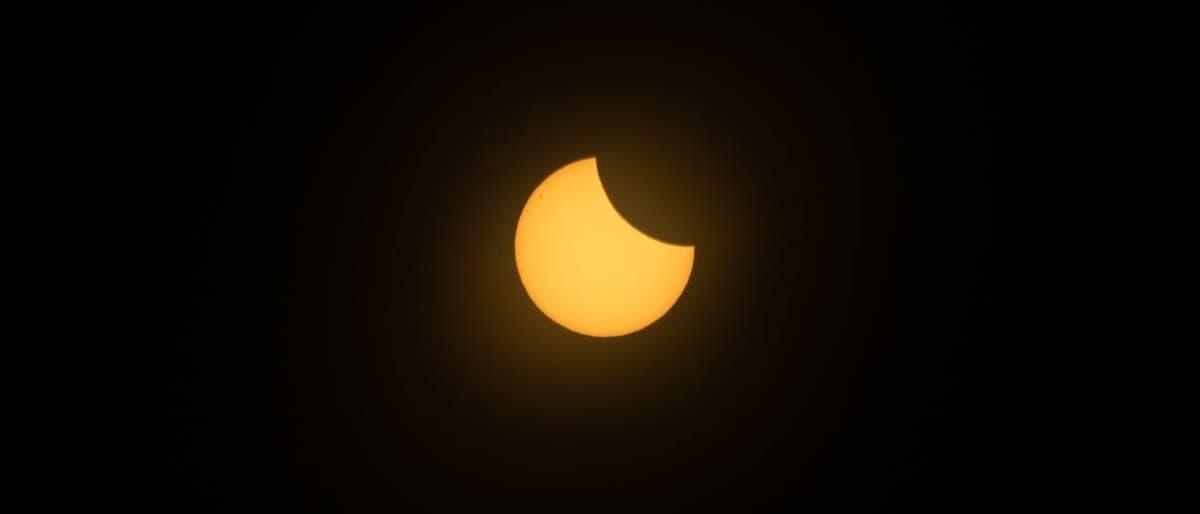
As the Moon begins its transit across the Sun, the partial phase looks identical to the beginning of any solar eclipse. Over the course of 1–2 hours, the Moon progressively covers more of the Sun's disk, creating a narrowing crescent. You must wear eclipse glasses throughout this phase.
Approaching Annularity
In the minutes before annularity begins, the crescent Sun becomes extremely thin. You may notice:
- Sharpening shadows: As the light source narrows, shadows become razor-thin
- Shadow bands: Faint, rippling patterns of light may appear on flat surfaces
- Color changes: The light may take on a slightly metallic or silvery quality
- Temperature drop: A modest cooling occurs as less sunlight reaches the ground
- Venus visibility: If Venus is favorably placed, it may become visible 1–2 minutes before annularity
Annularity: The Ring of Fire
When second contact arrives, the last sliver of the Sun's edge disappears behind the Moon, but instead of the complete darkness of totality, a brilliant ring of sunlight remains visible around the Moon's dark silhouette. This is the Ring of Fire, and it is one of the most striking sights in astronomy.
Key characteristics of the Ring of Fire:
- Brightness: The ring is intensely bright, it is direct sunlight, not the filtered glow of the corona. You cannot look at it without eye protection.
- Width: For this eclipse, the ring is relatively wide because the Moon is well past apogee and appears significantly smaller than the Sun. The ring will be approximately 3–4% of the Sun's diameter in width.
- Shape: The ring appears perfectly circular when viewed from the center of the path, and slightly oval when viewed near the path's edges.
- Duration: Annularity lasts much longer than the totality of a total solar eclipse. In this eclipse, it lasts up to 7 minutes 51 seconds, nearly four times longer than the longest totality possible.
- No corona: Because sunlight is not completely blocked, the solar corona is NOT visible during an annular eclipse. This is perhaps the biggest visual difference from a total eclipse.
- No full darkness: The sky dims during annularity, but it does not turn dark. The landscape remains clearly visible, and the horizon does not show the 360-degree sunset effect of totality.
The End of Annularity
At third contact, the Moon begins to uncover the Sun's disk. A bright point of sunlight, sometimes called a "bead", appears on the opposite side of the Moon from where annularity began, and the Ring of Fire breaks. Over the next 1–2 hours, the Moon continues its transit, and the Sun gradually returns to its full disk.
How to Safely View an Annular Solar Eclipse
Safety during an annular eclipse is critical, and it differs from safety during a total solar eclipse. Because the Sun is never completely covered, there is never a safe moment to look without certified eye protection.
The Golden Rule of Annular Eclipse Viewing
Keep your eclipse glasses on at ALL times. There is no "totality" during an annular eclipse. There is no safe window for naked-eye viewing. The Ring of Fire is direct, unfiltered sunlight, and looking at it without protection can cause permanent eye damage in a fraction of a second.
Safe Viewing Equipment
| Equipment | Safety Rating | Notes |
|---|---|---|
| ISO 12312-2 certified eclipse glasses | Safe | Must be worn at all times |
| Shade 14 welding glass | Safe | Must be shade 14 or higher |
| Pinhole projector | Safe | Simple DIY; projects image onto surface |
| Solar filter on telescope (front aperture) | Safe | Filter must be at FRONT of telescope |
| Colander projection | Safe | Creates multiple small Sun images |
| Regular sunglasses | NOT Safe | Does not block enough radiation |
| Stacked sunglasses | NOT Safe | Still insufficient protection |
| Looking through camera viewfinder without filter | NOT Safe | Damages eyes and camera |
| Eyepiece solar filters | NOT Safe | Can crack from concentrated heat |
Common Misconceptions About Annular Eclipse Safety
"The Ring of Fire isn't as bright as the full Sun." False. The Ring of Fire is direct sunlight concentrated into a ring. The total light output is somewhat less than the full Sun, but the intensity per unit area is the same. It is just as dangerous to look at as the uneclipsed Sun.
"Sunglasses are enough for an annular eclipse." Absolutely false. Even the darkest sunglasses provide nowhere near enough protection for direct solar viewing. Only ISO 12312-2 certified filters are safe.
"It's safe to look briefly, just a quick glance." No. Solar retinopathy can occur in less than one second of unprotected viewing. The retina has no pain receptors, so you may not realize damage has occurred until hours later when you notice a blind spot in your central vision.
Viewing with Children
Children are particularly at risk during an annular eclipse because they may not understand the danger and may be tempted to peek around their eclipse glasses. Supervise children closely, ensure their eclipse glasses fit properly, and consider using indirect viewing methods (pinhole projector, colander) as a safer alternative for young children.
Annular vs Total Solar Eclipse: Key Differences
While both annular and total solar eclipses involve the Moon passing in front of the Sun, the experience they offer is dramatically different. Here is a comprehensive comparison:
| Feature | Annular Eclipse | Total Eclipse |
|---|---|---|
| Moon's distance | Near apogee (farther) | Near perigee (closer) |
| Moon's apparent size | Smaller than Sun | Equal to or larger than Sun |
| Sun coverage | Incomplete (ring remains) | Complete |
| Maximum duration | Up to ~12 minutes | Up to ~7.5 minutes |
| Cornea visible? | No | Yes |
| Sky darkness | Partial dimming | Near-total darkness |
| 360° sunset effect | No | Yes |
| Stars/planets visible | Unlikely | Yes (brightest ones) |
| Temperature drop | Mild | Significant |
| Safe naked-eye moment | Never | During totality only |
| Emotional impact | Beautiful, awe-inspiring | Often described as life-changing |
| Frequency | Roughly every 1–2 years | Roughly every 1.5–2 years |
Why the Experiences Differ So Much
The fundamental difference comes down to whether the Sun is completely covered. During a total eclipse, the complete absence of direct sunlight transforms the environment, the sky darkens, the corona appears, and the world changes in ways that trigger deep emotional responses. During an annular eclipse, the persistent Ring of Fire means the environment never undergoes that transformation. The sky dims, but it never gets truly dark. The corona remains invisible. Animals may behave oddly, but not with the dramatic confusion seen during totality.
This is not to say annular eclipses are not worth experiencing. The Ring of Fire is a spectacular sight, the combination of the perfectly dark Moon silhouette surrounded by a blazing ring of sunlight against a dimmed sky is visually stunning and photographically rewarding. It is simply a different kind of experience, one that emphasizes beauty and precision over the visceral awe of totality.
Photography Tips for Annular Eclipses
Photographing an annular eclipse shares many techniques with total eclipse photography, but with some key differences, most notably, the solar filter must remain on your lens at ALL times.
Equipment
| Equipment | Recommendation |
|---|---|
| Camera body | DSLR or mirrorless with manual mode |
| Lens | 400mm+ for close-ups; 200mm for wider framing |
| Solar filter | ISO 12312-2 certified filter for your lens diameter |
| Tripod | Essential for sharp images |
| Remote shutter | Prevents camera shake |
| Intervalometer | For time-lapse sequences |
Exposure Settings
| Phase | ISO | Aperture | Shutter Speed | Solar Filter? |
|---|---|---|---|---|
| Partial eclipse | 100 | f/8 | 1/500–1/1000s | YES |
| Approaching annularity (thin crescent) | 100 | f/8 | 1/250–1/500s | YES |
| Ring of Fire | 100 | f/8 | 1/250–1/500s | YES |
| Ring of Fire (dramatic exposure) | 100 | f/11 | 1/1000–1/2000s | YES |
Unlike total eclipse photography, you do not remove the solar filter during an annular eclipse. The exposure settings remain relatively constant because the Ring of Fire's brightness does not change dramatically.
Creative Techniques
Solar filter on/off composite: Some photographers remove the solar filter during annularity to capture a single brief exposure of the Ring of Fire (with lens covered, remove filter, take one shot at very fast shutter speed like 1/8000s, replace filter). This is risky, you must be extremely careful not to look through the viewfinder without the filter, and the camera sensor can be damaged by prolonged exposure. This technique should only be attempted by experienced astrophotographers.
Landscape with Ring of Fire: Use a wide-angle lens to capture the Ring of Fire above a scenic foreground. In Argentina's Patagonia or Tanzania's savannas, the combination of dramatic landscapes and the celestial ring can create iconic images.
Sequence composite: Take a photo every 2–5 minutes throughout the eclipse and composite them into a single image showing the Sun's progression from full disk through crescent, Ring of Fire, crescent, and back to full disk.
Partial Visibility Regions
Outside the path of annularity, the February 6, 2027 eclipse will be visible as a partial solar eclipse across a wide area. The partial eclipse will be visible from:
- South America: Most of the continent, including Brazil, Uruguay, Paraguay, Peru, and Bolivia
- Africa: The entire continent, from Morocco to South Africa
- Southern Europe: Portugal, Spain, southern France, Italy, Greece
- Middle East: Limited visibility from the eastern Mediterranean
Partial Eclipse Coverage for Selected Cities
| City | Approximate Sun Coverage |
|---|---|
| São Paulo, Brazil | ~40% |
| Rio de Janeiro, Brazil | ~45% |
| Buenos Aires, Argentina | ~60% |
| Cape Town, South Africa | ~60% |
| Lagos, Nigeria | ~70% |
| Nairobi, Kenya | ~85% |
| Madrid, Spain | ~25% |
| Lisbon, Portugal | ~30% |
| Rome, Italy | ~15% |
Even at 60–70% coverage, the Sun remains dangerously bright. Eclipse glasses are required at all times when viewing the partial phases, regardless of coverage percentage.
Future Eclipses After February 2027
The February 2027 annular eclipse is part of an extraordinary sequence of eclipses in 2026–2028. Here is what comes next:
| Date | Type | Path | Maximum Duration |
|---|---|---|---|
| Aug 2, 2027 | Total | N Africa, Middle East, S Asia | 6m 23s |
| Jan 26, 2028 | Annular | S America, Atlantic, W Europe, N Africa | 10m 27s |
| Jul 22, 2028 | Total | SE Asia, Australia, New Zealand | 5m 10s |
The August 2, 2027 total solar eclipse is the big one, with over 6 minutes of totality crossing Egypt, Saudi Arabia, and India, it will be one of the longest and most accessible total eclipses of the 21st century. If you are planning an eclipse trip, the August 2027 event may be the best investment of the decade.
The January 26, 2028 annular eclipse is also notable, with an extremely long annularity of over 10 minutes crossing from South America through the Atlantic and into southwestern Europe and northwestern Africa, an extraordinary duration that will allow for extended photography and observation.
Explore More
- August 12 Total Solar Eclipse, This year's total eclipse.
- August 27-28 Partial Lunar Eclipse, This year's lunar eclipse.
- Equinoxes and Solstices 2026, Seasonal milestones.
- When Is the Next Solar Eclipse?, All upcoming eclipses through 2027.
Frequently Asked Questions
10 questions answered
What is an annular solar eclipse?
When is the February 6, 2027 annular eclipse?
Can I look at the Ring of Fire without eye protection?
How long does the Ring of Fire last?
Where is the best place to see the February 2027 annular eclipse?
How is an annular eclipse different from a total eclipse?
Will this eclipse be visible from the United States?
What is the "Ring of Fire"?
When is the next annular solar eclipse after February 2027?
Can I photograph the annular eclipse with my phone?
Put this into action
Stop guessing. Use our professional tools to schedule, convert, and manage time zones perfectly, 100% free.
Track Sky EventsOfficial Sources & References
- NASA Science: official data and scientific overviews for astronomical events and missions.