Perseid Meteor Shower 2026: Peak Dates, Best Viewing Times & Complete Guide
Quick Answer
The Perseid meteor shower peaks on the night of August 12–13, 2026, with an expected Zenithal Hourly Rate of approximately 100 meteors per hour. 2026 offers exceptional viewing conditions because the New Moon falls on August 11, leaving the entire peak night virtually moon-free, the best Perseid viewing opportunity since 2024 and the finest until 2028.
Also Today: Total Solar Eclipse
August 12, 2026 is a rare double astronomical event. Before the Perseids peak tonight, a total solar eclipse crosses Greenland, Iceland, and Spain during the day. If you're in the path of totality, you can witness BOTH events on the same day.
August 12, 2026 Total Solar Eclipse: Complete GuideWhat Are the Perseids?
The Perseids are the most popular and widely observed meteor shower in the Northern Hemisphere, and for good reason. They arrive during the warm nights of mid-August when stargazing is comfortable, they produce reliably high rates of bright meteors, and they're active for several weeks, giving multiple opportunities to catch the show.
The Parent Comet: 109P/Swift-Tuttle
The Perseids originate from Comet 109P/Swift-Tuttle, the largest known object that regularly passes close to Earth. Discovered independently by astronomers Lewis Swift and Horace Tuttle in 1862, this comet follows an elongated orbit that brings it through the inner solar system every 133 years. Its most recent perihelion passage was in 1992, and it will next return in 2126.
As Swift-Tuttle approaches the Sun, solar heating causes its icy nucleus, estimated to be about 16 miles (26 km) across, to release vast quantities of dust, ice crystals, and rocky debris. These particles spread out along the comet's orbital path, forming a broad debris stream that Earth encounters each year from approximately July 17 through August 24.
The 1992 perihelion passage deposited a particularly dense batch of fresh debris, and Perseid rates were elevated in the years following that return. While activity has gradually returned to more typical levels, the shower remains one of the strongest and most consistent annual displays.
The Radiant in Perseus
Perseid meteors appear to radiate from a point in the constellation Perseus, specifically near the star Eta Persei. This radiant rises in the northeast in the late evening for northern observers and climbs highest in the pre-dawn hours. The higher the radiant is in your sky, the more meteors you'll see, because more of the debris stream is above your horizon.
It's worth noting that meteors can appear anywhere in the sky, not just near the radiant. In fact, the shortest, least impressive meteors tend to be near the radiant itself, while those farther away show longer, more dramatic trails. The key is simply that all Perseid trails, if traced backward, converge at the radiant point.
Why 2026 Is Especially Good for Perseids
The biggest factor affecting Perseid viewing quality is the Moon. A bright Moon can reduce visible meteor counts by 50% or more, washing out all but the brightest fireballs. Unfortunately, because the Perseids occur at roughly the same time each year and the Moon's cycle is about 29.5 days, the Perseids contend with moonlight roughly every three years.
The 2026 Moon Advantage
In 2026, the New Moon occurs on August 11 at approximately 17:37 UTC, just one day before the Perseid peak. This means:
- On the peak night of August 12–13, the Moon is a thin waxing crescent at roughly 2–5% illumination
- The Moon sets within 30–60 minutes of sunset, completely disappearing from the evening sky
- The entire night is free of moonlight, from dusk through dawn
- Even on August 13–14 (the night after peak), the crescent Moon sets by about 9:00–10:00 PM local time
This is as good as it gets for Perseid viewing. The last time the Perseids enjoyed comparable conditions was 2024, and the next comparable opportunity won't come until 2028. If you've been waiting for the perfect year to really experience the Perseids, 2026 is it.
Comparison with Recent Years
| Year | Moon Phase at Peak | Moon Interference | Overall Rating |
|---|---|---|---|
| 2023 | Waning crescent (~30%) | Low–Moderate | Good |
| 2024 | New Moon | None | Excellent |
| 2025 | Waning gibbous (~60%) | High | Poor |
| 2026 | New Moon | None | Excellent |
| 2027 | Waxing gibbous (~70%) | High | Poor |
Best Viewing Times Tonight
The table below shows the best window for watching Perseids from major cities on the peak night of August 12–13, 2026. All times are approximate local time.
| City | Best Viewing Window | Expected Meteors/Hour | Moon Status |
|---|---|---|---|
| New York | 10:00 PM – 4:30 AM | 60–80 | Set by 9:00 PM |
| Los Angeles | 9:30 PM – 4:00 AM | 50–70 | Set by 8:30 PM |
| London | 10:30 PM – 4:30 AM | 70–90 | Set by 9:30 PM |
| Paris | 10:30 PM – 4:30 AM | 70–90 | Set by 9:30 PM |
| Reykjavik | 11:00 PM – 4:00 AM | 80–100 | Set by 10:00 PM |
| Tokyo | 11:00 PM – 3:30 AM | 20–40 | Set by 9:00 PM |
| Sydney | Limited viewing | 5–15 | Not visible most of night |
Meteor counts assume dark skies away from city lights. Light pollution can reduce visible meteors by 50–80%. Use our Time Zone Converter to adjust times for your specific location.
Peak Dates and Best Viewing Times
When Is the Exact Peak?
The Perseid peak in 2026 is predicted to occur around 14:00–20:00 UTC on August 12, which means the peak activity falls during daylight hours for the Americas but during the evening and overnight for Europe and Asia. However, the Perseids have a broad activity profile, unlike the Quadrantids, which spike and drop within hours, the Perseids maintain elevated rates for a full day or more on either side of the peak.
The Bottom Line on Timing
For observers in the Americas, the best strategy is to observe on both the night of August 12–13 (Wednesday night) and August 13–14 (Thursday night). European and Asian observers get the closest approach to the theoretical peak on the night of August 12–13. But honestly, any clear night from August 10 through August 15 will show a rewarding number of Perseids in 2026.
Timing Table by Time Zone
| City | Time Zone | Best Night | Prime Viewing Hours |
|---|---|---|---|
| New York | EDT (UTC−4) | Aug 12–13 | 11:00 PM – 4:30 AM |
| Chicago | CDT (UTC−5) | Aug 12–13 | 10:30 PM – 4:15 AM |
| Denver | MDT (UTC−6) | Aug 12–13 | 10:00 PM – 4:00 AM |
| Los Angeles | PDT (UTC−7) | Aug 12–13 | 9:30 PM – 3:45 AM |
| Anchorage | AKDT (UTC−8) | Aug 12–13 | 10:00 PM – 3:30 AM |
| Honolulu | HST (UTC−10) | Aug 12–13 | 9:00 PM – 3:00 AM |
| London | BST (UTC+1) | Aug 12–13 | 10:30 PM – 3:30 AM |
| Paris | CEST (UTC+2) | Aug 12–13 | 10:30 PM – 3:30 AM |
| Athens | EEST (UTC+3) | Aug 12–13 | 10:30 PM – 3:15 AM |
| Dubai | GST (UTC+4) | Aug 12–13 | 10:00 PM – 3:00 AM |
| Mumbai | IST (UTC+5:30) | Aug 12–13 | 10:00 PM – 4:00 AM |
| Tokyo | JST (UTC+9) | Aug 12–13 | 9:30 PM – 2:30 AM |
| Sydney | AEST (UTC+10) | Aug 12–13 | 1:00 AM – 4:30 AM |
The Pre-Dawn Sweet Spot
The absolute best viewing comes in the last two hours before dawn, when the Perseus radiant is nearly overhead for mid-northern observers. This is when you're facing directly into Earth's direction of travel, like standing on the front windshield of a car driving through a swarm of bugs. During this window, meteor rates can be 50–100% higher than earlier in the night.
How Many Meteors Per Hour to Expect
The Perseids have a ZHR of approximately 100, but as explained in our meteor showers guide, ZHR represents ideal theoretical conditions. Your actual count depends on sky darkness, radiant altitude, and personal factors.
Realistic Rates by Sky Condition
| Sky Condition | Bortle Class | Perseids Per Hour (Peak) |
|---|---|---|
| Outstanding dark site | 1–2 | 70–100+ |
| Good rural site | 3 | 50–70 |
| Rural/suburban transition | 4 | 30–50 |
| Suburban | 5 | 15–25 |
| Suburban/urban edge | 6 | 5–15 |
| Urban | 7+ | 0–3 |
The difference between a Bortle 2 site and a Bortle 5 site is enormous, you might see 5–7 times more meteors from the dark location. If at all possible, travel to a dark site for the 2026 Perseids. The moonless conditions mean that every meteor above your limiting magnitude will be visible, so dark skies will pay off more than usual.
ZHR vs. Actual Rates: Why the Numbers Differ
Several factors reduce the actual number of meteors you'll see compared to the ZHR:
-
Radiant altitude: The Perseid radiant is rarely at the zenith. When it's lower in the sky, fewer meteors are visible because half the activity is below your horizon.
-
Light pollution: Artificial light reduces the number of faint meteors you can detect.
-
Obstructions: Trees, buildings, and clouds block portions of the sky.
-
Observer fatigue: Your attention naturally wanders during long sessions. Studies show most observers miss 10–20% of visible meteors.
-
Personal visual acuity: Age, experience, and individual eye sensitivity all play a role.
How to Watch the Perseids
The Perseids are one of the easiest meteor showers to enjoy because they occur during warm summer weather and produce high rates of bright meteors. No special equipment is needed, just your eyes and a comfortable setup.
Choose Your Location Wisely
Use a light pollution map to find the darkest site within reasonable driving distance. State parks, national forests, and rural areas away from major highways are ideal. An open field with unobstructed views in all directions is perfect.
The 20-Minute Dark Adaptation Rule
This cannot be emphasized enough: give your eyes at least 20 minutes to adapt to the dark. Your pupils dilate over the first few minutes, but true dark adaptation, involving chemical changes in your rod cells, continues for 15–20 minutes. During this time, avoid ALL white light. A single glance at a phone screen can set you back 5–10 minutes.
If you must use light, use a dim red flashlight or enable your phone's red-screen mode (available in most astronomy apps). Red light affects your rod cells far less than white light.
Optimal Viewing Position
Lie back on a reclining lawn chair, a sleeping pad, or a blanket. Looking straight up gives you the widest possible field of view. Don't bother with binoculars or telescopes, they restrict your view to a tiny patch of sky, and meteors are too fast and unpredictable to track with magnified optics.
What to Wear and Bring
August nights can be deceptively cool, especially after 2:00 AM. Dew is also common, so plan accordingly.
| Item | Why You Need It |
|---|---|
| Long pants and a jacket | Temperatures can drop 20–30°F after midnight |
| Blanket or sleeping bag | Stay warm during extended sessions |
| Reclining chair | Prevents neck strain from looking up |
| Insect repellent | August mosquitoes can be brutal |
| Snacks and water | Stay energized for 4–6 hour sessions |
| Red flashlight | Navigate without ruining dark adaptation |
| Star map or app | Identify constellations and the radiant |
Photography Guide for the Perseids
The Perseids are one of the most photographed meteor showers, and 2026's excellent conditions make it a prime opportunity to capture stunning images.
Essential Camera Settings
| Setting | Recommended Value | Notes |
|---|---|---|
| Lens | 14–24mm, f/2.8 or faster | Wider and faster is better |
| Focal length | 14–20mm | Maximize sky coverage |
| Aperture | f/2.8–f/1.4 | Let in maximum light |
| ISO | 1600–3200 | Balance sensitivity and noise |
| Shutter speed | 15–25 seconds | Avoid star trailing |
| White balance | 3500–4500K | Natural-looking night sky |
| File format | RAW | Maximum editing flexibility |
| Drive mode | Continuous | Catch as many meteors as possible |
Step-by-Step Setup
-
Mount your camera on a sturdy tripod. Any vibration will blur your stars.
-
Set your lens to manual focus. Autofocus will hunt and fail in the dark.
-
Focus on a bright star. Use live view at 10x magnification and adjust until the star is a sharp point. Some photographers use the "tape trick", once focused, tape the focus ring in place.
-
Aim your camera. Point it roughly 40–60 degrees from the radiant and 40–50 degrees above the horizon. This captures meteors with the longest trails.
-
Include a foreground. A silhouetted tree line, mountain, or lake adds depth and context to your meteor photos.
-
Start shooting. Use an intervalometer or your camera's built-in interval timer to shoot continuously. Set a 1–2 second gap between exposures to ensure you don't miss a meteor during the gap.
Advanced Techniques
Stacking: Combine multiple exposures to show the shower's activity over time. Software like Starry Landscape Stacker (Mac) or Sequator (Windows) aligns the stars and lets you add meteor trails from individual frames into a single composite image.
Time-lapse: Set your camera to shoot continuously throughout the night and compile the frames into a video. At 15-second exposures, you'll capture roughly 240 frames per hour, a 6-hour session yields about 1,440 frames, which at 30fps makes a 48-second time-lapse.
Tracking mount: For the sharpest possible stars, use a motorized star tracker that rotates your camera to follow the sky's motion. This allows longer exposures (60+ seconds) without star trailing, revealing fainter meteors and richer star fields.
Quick Perseid Photography Setup
Here's a compact reference card for Perseid photography settings. Print this out or save it to your phone before heading out.
| Setting | Recommended Value |
|---|---|
| Camera | DSLR or mirrorless, manual mode |
| Lens | Wide-angle, 14–24mm, f/2.8 or faster |
| ISO | 1600–6400 |
| Shutter Speed | 15–25 seconds |
| Aperture | f/2.8 or widest available |
| Focus | Manual, set to infinity |
| Intervalometer | Take shots every 20–30 seconds |
Perseid Fireballs: What Makes Them Special
One of the Perseids' most beloved characteristics is their tendency to produce bright fireballs, meteors that reach magnitude –3 or brighter, outshining the planet Venus. The Perseids have one of the highest fireball rates of any annual shower, and NASA's fireball network consistently logs more Perseid fireballs than those from any other shower.
Why So Many Fireballs?
Swift-Tuttle's large nucleus (about 16 miles / 26 km across) produces a debris stream that contains a higher proportion of larger particles than most comet debris streams. When these bigger particles, even small ones, perhaps the size of a pea or a marble, slam into the atmosphere at 133,000 mph (214,000 km/h), they release tremendous energy and produce exceptionally bright meteors.
Identifying Perseid Fireballs
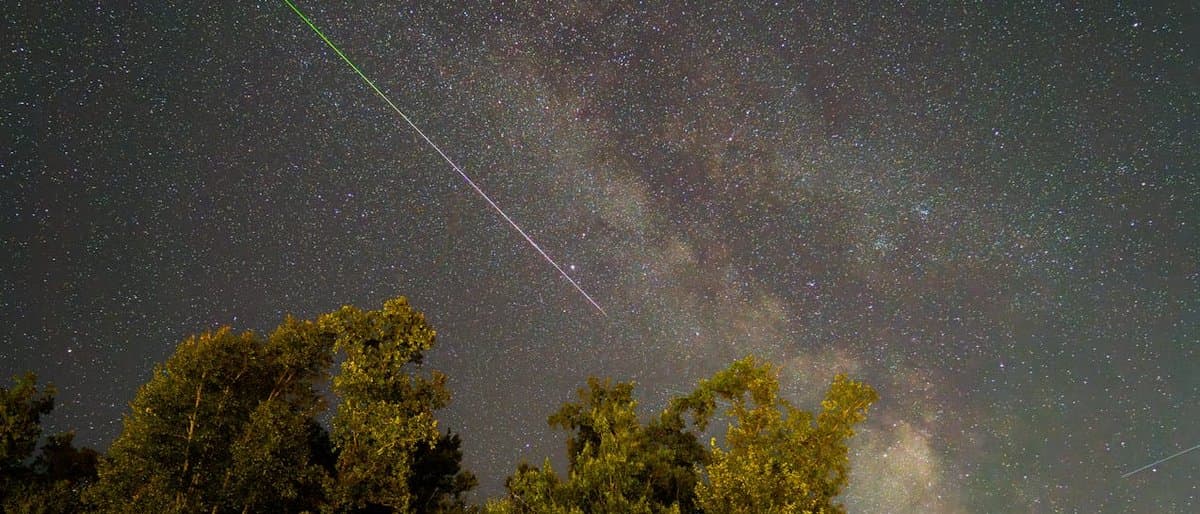
Perseid fireballs are typically bright white or greenish-white, with some showing a brief flash or fragmentation near the end of their trail. Roughly one-third of Perseid fireballs leave persistent trains, luminous afterglows that can last from a fraction of a second to several seconds. These trains are caused by ionized gas in the meteor's wake that takes time to recombine and fade.
Reporting Fireballs
If you see an exceptionally bright meteor, consider reporting it to the American Meteor Society (AMS) at amsmeteors.org. Your report, including the time, direction, brightness estimate, and duration, helps scientists track fireball activity and can even contribute to meteorite recovery efforts in rare cases where a fragment survives to reach the ground.
The Perseids 2027: When Do the Perseids Peak Next Year?
The Perseid meteor shower 2027 peaks on the night of August 12–13, 2027, with a maximum ZHR near 100 as always, but the headline is the Moon: the 2027 peak lands under a waxing gibbous moon, roughly 90% illuminated, which stays up most of the night and washes out the fainter meteors. Realistically expect 25–40 per hour at a dark site instead of 2026's 60–100, with only the bright fireballs punching through. The shower's parent comet, 109P/Swift-Tuttle, returns every 133 years, but the debris stream itself is stable, the rate ceiling never changes; only the sky conditions do. If you're planning moon-dark Perseids after 2026, the calendar favors 2028. Bookmark this page: the full 2027 viewing guide goes up in July.
What time do the Perseids peak in 2027?
Overnight August 12 into pre-dawn August 13, 2027, with the best hours between midnight and dawn as usual, but plan around a bright gibbous Moon overhead, and target the hours right before dawn when the radiant climbs highest.
Other Meteor Showers in August
While the Perseids dominate August's meteor calendar, they aren't the only active shower this month. Understanding these overlapping showers helps you distinguish true Perseids from interlopers.
Delta Aquariids (Southern Delta Aquariids)
The Delta Aquariids peak in late July but remain active through mid-August, overlapping with the Perseids. They produce a ZHR of about 20–25 and radiate from the constellation Aquarius, much farther south than the Perseid radiant. Delta Aquariid meteors are typically fainter and slower than Perseids.
Alpha Capricornids
This very minor shower is active from July 3 through August 15, with a ZHR of only about 5. However, the Alpha Capricornids are known for producing a relatively high percentage of bright, slow-moving fireballs. Their radiant is in the constellation Capricornus, low in the southern sky for northern observers.
Distinguishing Between August Showers
| Feature | Perseids | Delta Aquariids | Alpha Capricornids |
|---|---|---|---|
| Speed | Fast | Medium | Slow |
| Typical brightness | Bright | Faint | Bright |
| Radiant | Perseus (NE) | Aquarius (S) | Capricornus (S) |
| Color | White/green | Faint white | Yellow/orange |
| Trail | Often persistent | Brief | Can be long |
To confirm a meteor's identity, trace its path backward. If the line points toward Perseus, it's a Perseid. If it points toward Aquarius or Capricornus, it belongs to one of the southern showers.
More 2026 Sky Events
August 12 Total Solar Eclipse
Same day as the Perseid peak, a total eclipse crosses Greenland, Iceland, and Spain.
Read moreAll 2026 Meteor Showers
Lyrids, Eta Aquariids, Perseids, Orionids, Geminids, every major shower in 2026.
Read moreAugust 28 Partial Lunar Eclipse
Two weeks after the solar eclipse, a partial lunar eclipse graces the Americas.
Read moreMoon Phases 2026
New moon dates, full moon dates, and supermoons throughout the year.
Read moreAutumn Equinox 2026
The next seasonal milestone after the Perseids, September 22, 2026.
Read moreWhen Is the Next Lunar Eclipse?
Upcoming lunar eclipses through 2030.
Read moreFrequently Asked Questions
11 questions answered
When is the Perseid meteor shower in 2026?
How many Perseids will I see in 2026?
Is 2026 a good year for the Perseids?
What time should I go outside to watch the Perseids?
Do I need a telescope or binoculars?
Can I see the Perseids from the Southern Hemisphere?
What causes Perseid meteors?
Why are the Perseids called the Perseids?
How long do Perseid meteors last?
Can I photograph the Perseids with a smartphone?
What if it's cloudy on the peak night?
Put this into action
Stop guessing. Use our professional tools to schedule, convert, and manage time zones perfectly, 100% free.
Track Sky EventsOfficial Sources & References
- NASA Science: official data and scientific overviews for astronomical events and missions.