Hanukkah 2026: When It Starts, Candle-Lighting Times, and Why It's Early
Quick Answer
Hanukkah 2026 begins at sundown on Friday, December 4, 2026, and runs for eight nights, ending after nightfall on Saturday, December 12. This year's festival carries a quirk that comes around only occasionally: the first night falls on Erev Shabbat, so the first candles are lit before the Shabbat candles — before sundown — and the second night waits until Havdalah, after Shabbat ends. The eighth night, on Friday, December 11, lands on the eve of Shabbat too.
Hanukkah 2026 at a Glance
| Question | Answer |
|---|---|
| First candle | Friday night, December 4, 2026 — lit before sundown (before Shabbat candles) |
| Eighth night | Friday night, December 11, 2026 — also lit before sundown |
| Festival ends | After nightfall on Saturday, December 12, 2026 |
| Hebrew dates | 25 Kislev – 2 Tevet, year 5787 |
| Length | Eight nights |
| 2025 comparison | Began December 14 — 2026 is ten days earlier |
| Next year | Hanukkah 2027 begins at sundown on December 24, 2027 |
The Eight Nights of Hanukkah 2026
Each night adds one candle, so the festival's shape is a count-up: one flame on the first night, eight on the last. Here is how the eight nights fall in 2026:
| Night | Evening of | Notes |
|---|---|---|
| 1st candle | Friday, December 4 | Erev Shabbat — light before sundown, before the Shabbat candles |
| 2nd candle | Saturday, December 5 | Shabbat — light after nightfall, after Havdalah |
| 3rd candle | Sunday, December 6 | Standard night — at nightfall |
| 4th candle | Monday, December 7 | Standard night |
| 5th candle | Tuesday, December 8 | Standard night |
| 6th candle | Wednesday, December 9 | Standard night |
| 7th candle | Thursday, December 10 | Standard night |
| 8th candle | Friday, December 11 | Erev Shabbat again — light before sundown |
| — | Saturday, December 12 | The eighth day — the festival's final day, no new lighting |
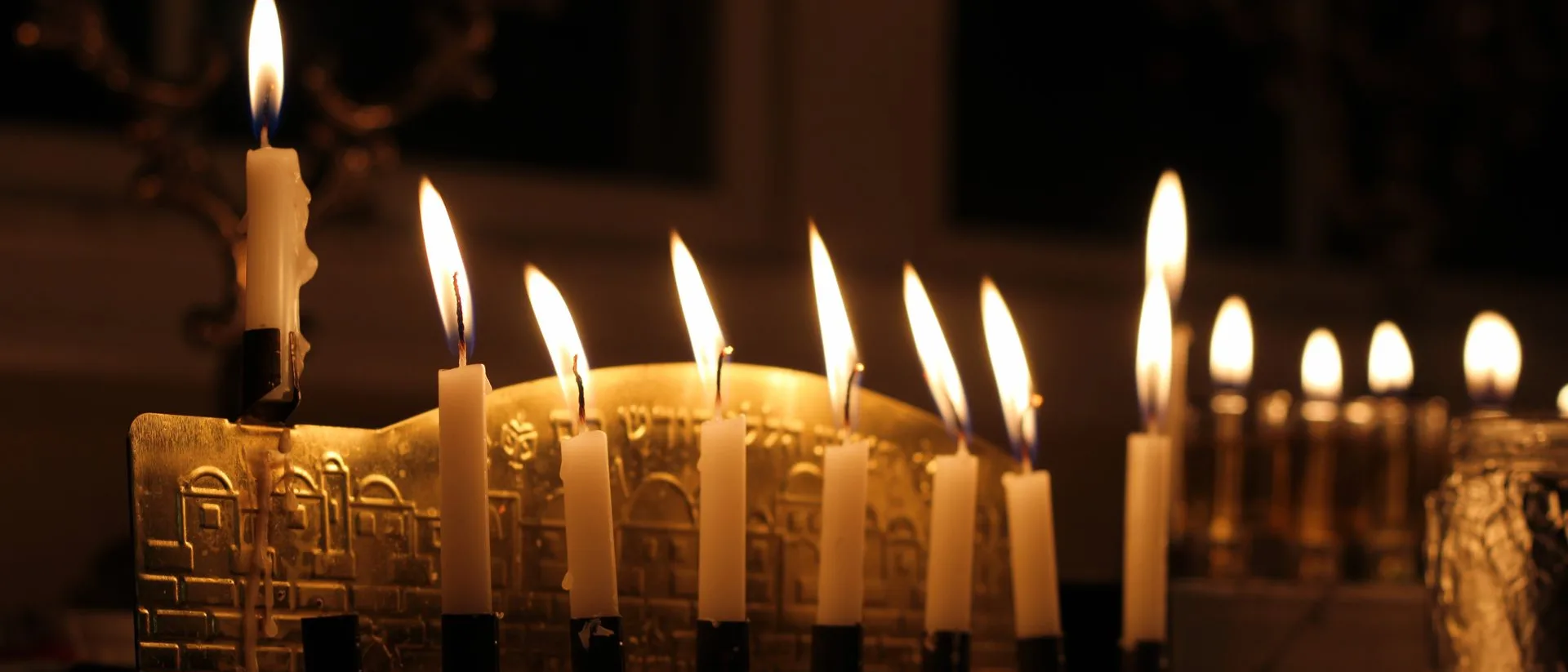
The candles are always lit in the same order each night — right to left, starting from the leftmost position — and the ninth candle, the shamash ("helper"), is lit first and used to light the others. It stays in its raised position on the hanukkiah.
Candle-Lighting Times for Major Cities
Jewish law ties candle-lighting to the sun, not the clock: on Hanukkah, the candles are kindled at sundown, though community custom refines "sundown" in different ways — most communities light at nightfall, roughly 30–45 minutes after sunset, on ordinary weeknights. On Friday, when Shabbat begins, the candles are lit before sunset — in practice, at the same time as the Shabbat candles, commonly 18–20 minutes before sundown (40 minutes in Jerusalem and a few other cities with their own customs).
The table below gives sundown (shkiah) for Friday, December 4, 2026 in major cities, computed for this site's own solar engine — the hard deadline for the first night's lighting. If you are in one of these cities, light (or attend a public lighting) before this time.
| City | Sundown — Friday, December 4, 2026 |
|---|---|
| Jerusalem | 4:34 p.m. |
| Tel Aviv | 4:35 p.m. |
| London | 3:53 p.m. |
| Paris | 4:55 p.m. |
| New York | 4:28 p.m. |
| Toronto | 4:41 p.m. |
| Chicago | 4:19 p.m. |
| Miami | 5:29 p.m. |
| Los Angeles | 4:43 p.m. |
| Sydney | 7:53 p.m. |
| Melbourne | 8:29 p.m. |
For the other nights of the festival, the pattern shifts by seconds, not minutes — sundown on December 5 is within about a minute of December 4 in most of these cities — so the weeknight lighting time stays remarkably stable through the festival. In communities that light at nightfall rather than sunset, expect the candle-lighting moment to be roughly half an hour after the times above. When in doubt, use your community's published calendar, which accounts for local custom.
Why the First Night Falls on Shabbat
In the Hebrew calendar, days begin at sundown — so Friday evening is already Shabbat, and the first night of Hanukkah 2026 belongs to both observances at once. When that collision happens, one clear rule resolves it: on Friday, the Hanukkah candles are lit first, then the Shabbat candles — both before sundown. (On every other Friday of the year, the Shabbat candles come first. Hanukkah takes precedence during the festival because its lights mark a specific night, while Shabbat candles can be kindled any time before sundown.)
There is a practical consequence to lighting before sundown on Friday: the Hanukkah lights must be prepared to burn longer than usual, because they need to stay lit for at least half an hour after nightfall — otherwise the candles would gutter out during the Shabbat meal. This is why many families use larger candles or top off the oil on Friday evenings of Hanukkah.
The next evening, Saturday, the order runs the other way: Shabbat ends at nightfall, Havdalah is made, and then the Hanukkah candles are lit — the only night of the year when hanukkiah lighting follows a Havdalah. From Sunday onward, the festival returns to its normal rhythm of nightfall lighting.
Why Hanukkah Is Early This Year
Hanukkah always begins on 25 Kislev in the Hebrew calendar — a date fixed in the religious system, but one that slides across the Gregorian calendar, because the Hebrew year is lunisolar: its months follow the moon (about 29.5 days each), but the calendar adds a leap month seven times in every 19-year cycle to keep the festivals aligned with the seasons.
Twelve lunar months run about 354 days — roughly 11 days short of the solar year. So in plain years, Hanukkah drifts about ten or eleven days earlier on the Gregorian calendar. Then a leap year adds a full lunar month, and Hanukkah jumps roughly three weeks later instead. The result is a perpetual swing: on the Gregorian calendar, Hanukkah can begin anywhere from late November to late December.
That swing is why 2026 feels early. Last year's festival began December 14; this year's begins December 4 — a ten-day slide — and it happens to be the last move in that direction for a while, because 2027 swings the other way, opening on December 24.
| Year | First candle (sundown) | Festival ends |
|---|---|---|
| 2024 | December 25 | January 2, 2025 |
| 2025 | December 14 | December 22 |
| 2026 | December 4 | December 12 |
| 2027 | December 24 | January 1, 2028 |
| 2028 | December 12 | December 20 |
| 2029 | December 1 | December 9 |
| 2030 | December 20 | December 28 |
A familiar coincidence returns in 2027, when Hanukkah opens on Christmas Eve — the two holidays align much more often than people expect. This year, though, they are fully separate: Hanukkah wraps up on December 12, nearly two weeks before Christmas.
One Festival, Many First Candles
Because Hanukkah is tied to sundown, there is no single global "start time" for the festival — the first candle moves around the planet with the setting sun. For 2026, the sequence is dramatic. Sydney ushers in the festival at 7:53 p.m. local on Friday; by then, it is still pre-dawn of the same Friday in New York. The gap between the two cities' first candles is about 12½ hours. Jerusalem's lighting comes roughly seven hours before New York's; London's, about five and a half hours.
So when a New York family sits down to light the first candle on Friday evening, the festival is already in its second day in Sydney — and families in Europe have finished their first night's meal hours earlier. The same is true every year on Tisha B'Av, Purim, and every holiday whose clock is the sunset: the Hebrew calendar runs simultaneously in every time zone, each observance anchored to its own local sundown.
The Symbols in Brief
The festival itself commemorates the rededication of the Temple in Jerusalem in 164 BCE, after the Maccabean revolt — and the small cruse of oil that, according to the Talmud, burned for eight days instead of one. That story is why the holiday is built around fire and oil: the nine-branched hanukkiah (eight lights plus the shamash), the fried foods (latkes in the Ashkenazi tradition, sufganiyot — jelly doughnuts — in the Sephardi and Israeli tradition), and the little spinning top called a dreidel, whose four Hebrew letters stand for "a great miracle happened there."
There are no prescribed feasts or services at home beyond the nightly lighting and two blessings — which is exactly why Hanukkah, a modest festival in the religious calendar, became the most visible Jewish holiday in the winter landscape. Public lightings in city centers and giant menorahs in plazas have made the first night a communal event in many cities.
Frequently asked questions
When does Hanukkah start in 2026?
At sundown on Friday, December 4, 2026 — the first candle is lit that evening, before sundown because it is also the eve of Shabbat.
When does Hanukkah end in 2026?
The eighth night is Friday, December 11; the festival's final day is Saturday, December 12, 2026, ending after nightfall.
Why is Hanukkah early in 2026?
The Hebrew calendar is lunisolar, so Hanukkah slides between late November and late December on the Gregorian calendar. It moved about ten days earlier than 2025; in 2027 it will jump back about three weeks, to December 24.
What time are Hanukkah candles lit?
On ordinary nights, at nightfall — roughly 30–45 minutes after sundown, depending on community custom. On Friday, December 4 (and Friday, December 11), the candles are lit before sundown, at the same time as the Shabbat candles. On Saturday night, December 5, they are lit after Havdalah.
Is Hanukkah always eight nights?
Yes — eight nights, one candle added each evening, for a total of eight lights plus the shamash (helper candle), nine positions per hanukkiah.
When is Hanukkah 2027?
Hanukkah 2027 begins at sundown on Friday, December 24, 2027, and runs through January 1, 2028.
How do I find the candle-lighting time where I live?
Use your community's published candle-lighting calendar — it reflects local custom (18 minutes before sundown in many cities, 40 minutes in Jerusalem). Our sunrise and sunset calculator gives the exact sundown time for any location on the first night.
Explore More
- Thanksgiving 2026: Date, Countdown, Parade & Game Times — the holiday that opens December's run
- Christmas Countdown 2026: Live Count + the Full December Guide — the other December festival
- Cold Moon 2026: The Christmas Supermoon of December 23-24 — the full moon of the festival season
- New Year 2027 Countdown: When 2027 Starts Where You Live — how midnight sweeps the globe
- Sunrise & Sunset Calculator — sundown times for any city on the first night
- Holidays Hub — every major holiday with dates and countdowns
Put this into action
Stop guessing. Use our professional tools to schedule, convert, and manage time zones perfectly — 100% free.
Track Sky EventsOfficial Sources & References
- NASA Science — Official data and scientific overviews for astronomical events and missions.