January 2027 Moon Phases: Full Calendar, New Moon and Wolf Moon
Quick Answer
Slug: /articles/january-2027-moon-phases Primary keyword: january 2027 moon phases Meta title: January 2027 Moon Phases: Full Moon & Daily Calendar Meta description: See every January 2027 moon phase, including the January 7 new moon and January 22 full Wolf Moon, with exact UTC times and US local dates. Updated: October 2026
January 2027 Moon Phases: Full Calendar, New Moon and Wolf Moon
SEO title: January 2027 Moon Phases: Full Moon & Daily Calendar
Meta description: See every January 2027 moon phase, including the January 7 new moon and January 22 full Wolf Moon, with exact UTC times and US local dates.
Quick Answer: January 2027 has a new Moon on January 7 at 20:24 UTC, first quarter on January 15 at 20:34 UTC, a full Wolf Moon on January 22 at 12:17 UTC and last quarter on January 29 at 10:55 UTC. The January 3-4 Quadrantid meteor-shower peak comes before the new Moon, not on January 7. All four major January phase instants stay on the same local calendar date in New York and Los Angeles.
January 2027 at a glance
| Phase | UTC instant | New York local time | Los Angeles local time |
|---|---|---|---|
| New Moon | Jan 7, 20:24 | Jan 7, 3:24 PM EST | Jan 7, 12:24 PM PST |
| First Quarter | Jan 15, 20:34 | Jan 15, 3:34 PM EST | Jan 15, 12:34 PM PST |
| Full Moon | Jan 22, 12:17 | Jan 22, 7:17 AM EST | Jan 22, 4:17 AM PST |
| Last Quarter | Jan 29, 10:55 | Jan 29, 5:55 AM EST | Jan 29, 2:55 AM PST |
The times are from the U.S. Naval Observatory's 2027 primary-phase table. The U.S. conversions use time-zone rules for January, when New York is on EST and Los Angeles is on PST. The phase event is the same worldwide instant, not the time the Moon rises.
January 2027 Moon phase calendar, day by day
The month has 31 calendar days. Each row below gives a broad phase-state label, with a clock time only when a primary phase occurs on that UTC date. The labels between major phases describe the waxing or waning part of the cycle; they do not claim an exact illumination percentage for the day.
| Date (UTC) | Weekday | Moon state | Exact phase event (if any) |
|---|---|---|---|
| 1 | Fri | Waning crescent | None |
| 2 | Sat | Waning crescent | None |
| 3 | Sun | Waning crescent | None |
| 4 | Mon | Waning crescent | None |
| 5 | Tue | Waning crescent | None |
| 6 | Wed | Waning crescent | None |
| 7 | Thu | New Moon | 20:24 UTC |
| 8 | Fri | Waxing crescent | None |
| 9 | Sat | Waxing crescent | None |
| 10 | Sun | Waxing crescent | None |
| 11 | Mon | Waxing crescent | None |
| 12 | Tue | Waxing crescent | None |
| 13 | Wed | Waxing crescent | None |
| 14 | Thu | Waxing crescent | None |
| 15 | Fri | First Quarter | 20:34 UTC |
| 16 | Sat | Waxing gibbous | None |
| 17 | Sun | Waxing gibbous | None |
| 18 | Mon | Waxing gibbous | None |
| 19 | Tue | Waxing gibbous | None |
| 20 | Wed | Waxing gibbous | None |
| 21 | Thu | Waxing gibbous | None |
| 22 | Fri | Full Moon | 12:17 UTC |
| 23 | Sat | Waning gibbous | None |
| 24 | Sun | Waning gibbous | None |
| 25 | Mon | Waning gibbous | None |
| 26 | Tue | Waning gibbous | None |
| 27 | Wed | Waning gibbous | None |
| 28 | Thu | Waning gibbous | None |
| 29 | Fri | Last Quarter | 10:55 UTC |
| 30 | Sat | Waning crescent | None |
| 31 | Sun | Waning crescent | None |
This UTC-referenced table begins with a waning crescent because the preceding last quarter occurred on December 30, 2026 at 18:59 UTC. The Moon continues to thin before the January 7 new phase. The January 22 full phase appears only in January, not in a neighbouring February row.
For local date presentation, use the companion month-and-time-zone HTML component supplied with this article. It converts the exact phase event before assigning it to a calendar cell. That matters for monthly articles in general, even though all four January 2027 primary phase instants happen to retain their January day number in the two U.S. example zones.
A moon phase calendar is not a substitute for moonrise, moonset or illumination-at-a-chosen-time data. It tells you what part of the lunar cycle you are in. Whether the Moon is actually above your horizon at 9 PM requires your location and that night's rise/set calculation.
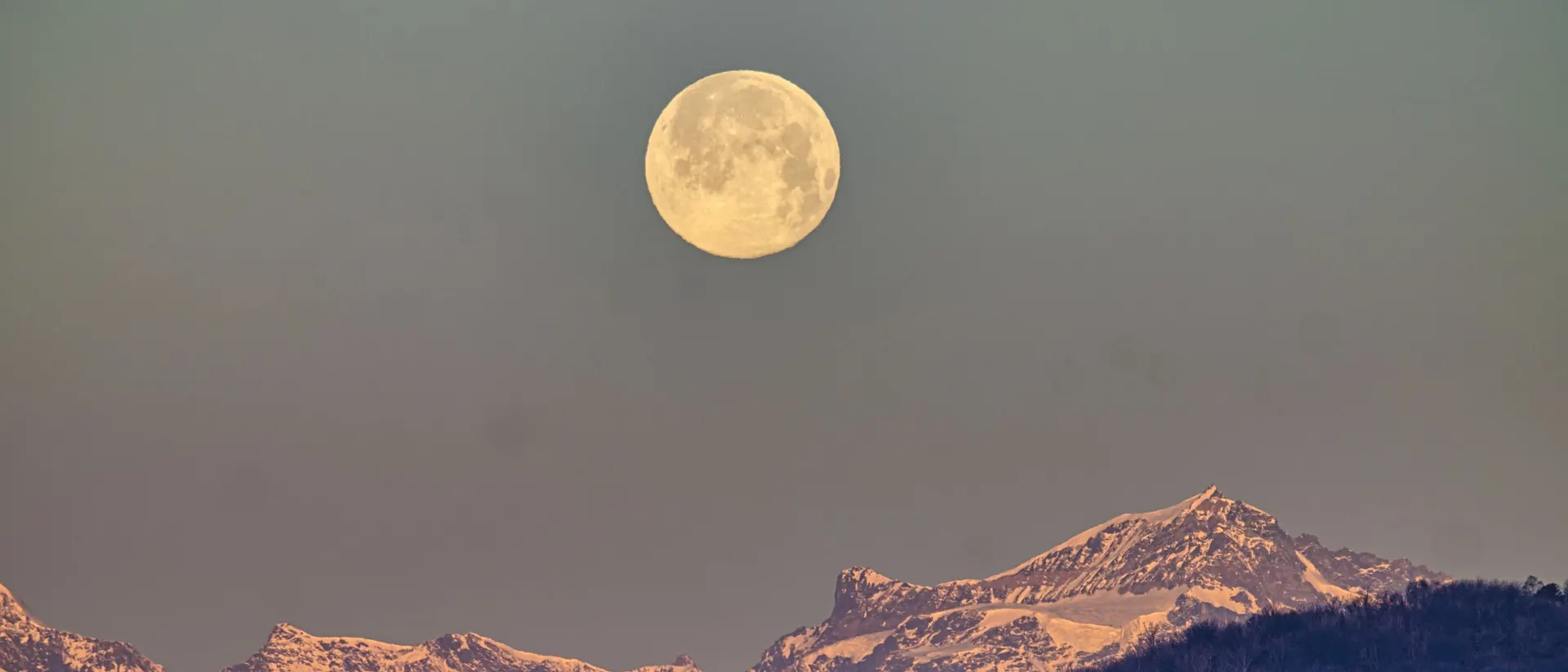
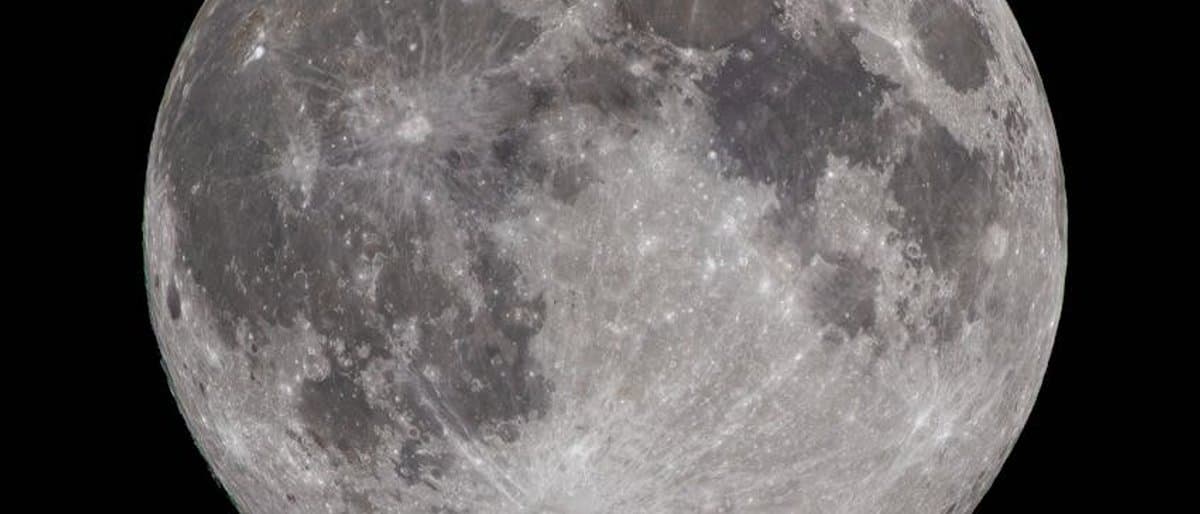
January 22: the full Wolf Moon
The U.S. Naval Observatory gives the January full phase as Friday, January 22, 2027 at 12:17 UTC. In New York that is 7:17 AM EST; in Los Angeles it is 4:17 AM PST. By evening in the continental U.S., the full-phase instant will already have passed, although the Moon will still look close to fully illuminated.
The full Moon is not a single evening that turns on at sunset. It is a moment defined by the Sun-Earth-Moon geometry. The Moon's visible brightness changes gradually before and after that moment, so the evenings around January 21 and 22 can both offer a nearly full-looking disc.
For a low Moon near the horizon, calculate your local moonrise for January 21, 22 or 23 and choose an evening with a clear eastern view. The exact UTC phase time is not a moonrise time. A full Moon can reach full phase while it is below your local horizon or in a daytime sky.
The name "Wolf Moon" appears in widely used English-language monthly full-Moon name lists. NASA traces the popular publication of many of these North American names to the Maine Farmers' Almanac and later almanac traditions. Historical explanations often refer to wolves heard during winter, but the name should not be presented as one universal tradition shared by every Indigenous nation.
This monthly calendar includes the Wolf Moon because readers want to know which date is full. A dedicated Wolf Moon guide, if published, should own location-specific viewing times, local date questions and photography advice. That material need not be repeated on every annual or monthly phase table.
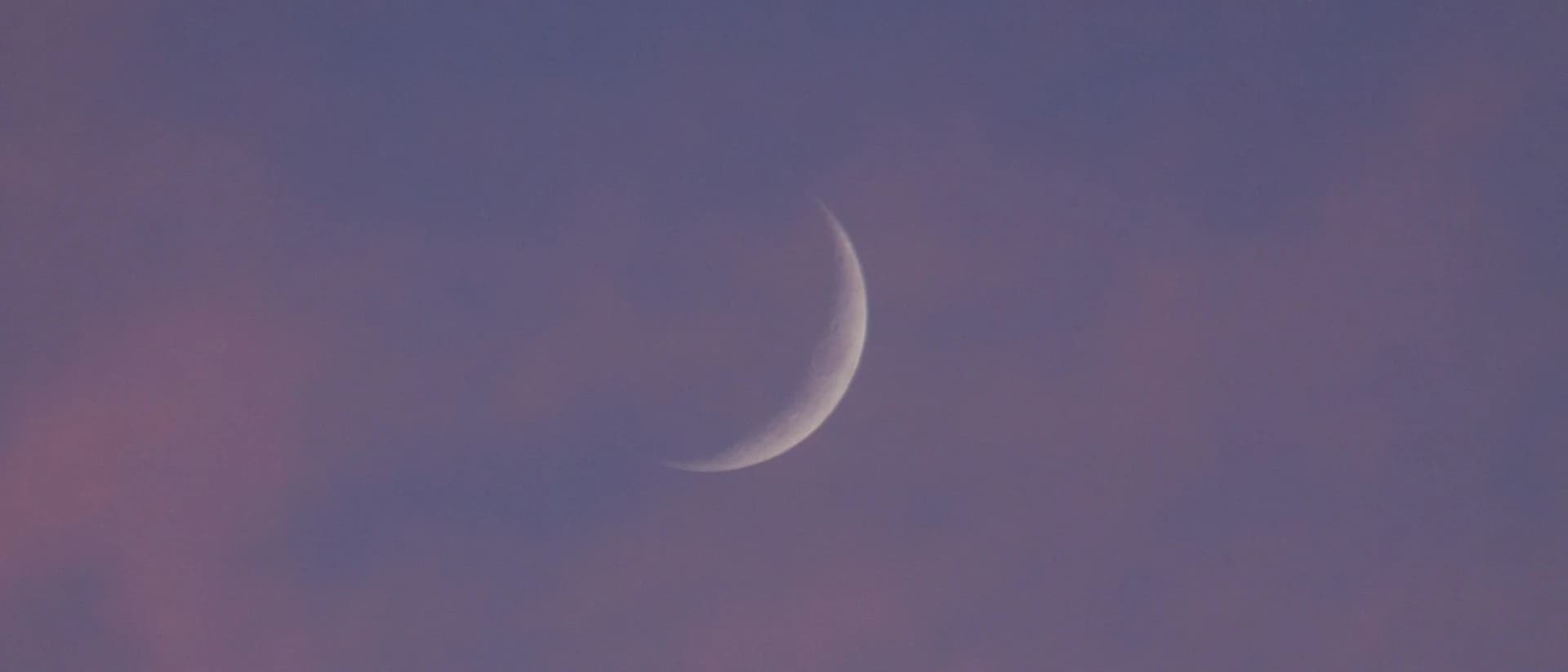
January 7 new Moon: useful for a dark sky
The new Moon falls on January 7 at 20:24 UTC. That is 3:24 PM EST in New York and 12:24 PM PST in Los Angeles, so the astronomical instant occurs during daylight for many U.S. readers. You cannot infer any evening moonrise from that afternoon timestamp.
Near new phase, the Moon stays near the Sun's direction in the sky. The nighttime sky can therefore be relatively free from moonlight, which helps with faint star fields and deep-sky observing. The darkest useful hours also require the Sun to be well below the horizon, so check local astronomical twilight and weather.
The nights on either side of January 7 may be good options. You do not have to wait for the precise UTC minute of new Moon. A clear January 6 or 8 with a moon-free observing period may be more useful than a cloudy January 7.
A new Moon does not guarantee a moonless horizon from sunrise to sunset, and it does not guarantee clear conditions. Light pollution remains present regardless of phase, and cloud can stop stargazing even when the Moon is below the horizon.
The Quadrantids peak before the new Moon
The American Meteor Society gives the 2027 Quadrantid peak night as January 3-4, with a forecast maximum near 03:30 UTC on January 4. It describes favourable lunar conditions because the Moon is a thin waning crescent during the peak. That is several days before the January 7 new Moon.
It would be incorrect to tell readers to watch the Quadrantids on January 7 simply because that is the darkest date in the phase calendar. The Quadrantids have a comparatively narrow maximum, so the shower timing matters. A clear January 3-4 can be more worthwhile than a moonless date after the sharp peak has passed.
The shower is better placed for northern latitudes. From some regions its radiant is most useful toward the latter part of the night. For an event-specific plan, use the Quadrantids 2027 guide after confirming that page is published, and consult the AMS peak forecast if planning before it goes live.
The AMS website also contains differing public estimates of observed Quadrantid rates, depending on whether it is describing standardized ZHR or a typical skywatcher's count. The monthly Moon article does not need to settle that rate question. It needs to keep the lunar condition and meteor-shower date separate.
First quarter on January 15
First quarter occurs January 15 at 20:34 UTC. The U.S. local times remain January 15: 3:34 PM in New York and 12:34 PM in Los Angeles. The Moon will be near half illuminated as seen from Earth, with the right-hand side typically lit for northern mid-latitude viewers when the lunar image is oriented conventionally.
First quarter is often a useful time to inspect the Moon's surface through binoculars or a small telescope. The dividing line between light and dark crosses prominent terrain and creates shadows that can make crater walls easier to pick out. You do not need an observatory to see the broad half-disc shape.
For general stargazing, first quarter brings a brighter early evening than new Moon. The Moon tends to set later in the night. If your interest is faint stars, check whether a moon-free interval opens after moonset instead of discarding the entire night.
The illuminated portion continues increasing after January 15, producing a waxing gibbous Moon on the way to January 22. This change is gradual and does not happen in a sharp visual jump as the calendar moves from one date to the next.
Last quarter on January 29 and the next cycle
The last-quarter instant is January 29 at 10:55 UTC. That is 5:55 AM EST in New York and 2:55 AM PST in Los Angeles. The Moon is approximately half illuminated again, but now in its waning half-cycle.
After last quarter, the Moon becomes a waning crescent and approaches the February 6 new Moon at 15:56 UTC. A waning crescent is most associated with the pre-dawn side of the daily sky rather than the early evening. Exact visibility still requires the rise/set geometry for your location.
If you want to plan a telescope session, lunar surface detail can look different at the two quarter phases because sunlight falls from a different direction. If you simply need dark evening skies, the phase progression tells you when moonlight tends to be less troublesome, but local Moon altitude matters as much as the phase name.
The next full Moon occurs February 20, 2027 at 23:23 UTC, according to USNO. That full phase is still February 20 in New York and Los Angeles at their winter standard-time offsets. For every month in the year, use the Moon phases 2027 calendar once its published URL is confirmed.
January phase times outside the United States
The U.S. calendar date is not universal. India is five and a half hours ahead of UTC, and Sydney is on Australian Eastern Daylight Time in January. A phase instant near the end of the UTC day can therefore appear on the following local date. This month provides two useful examples without any need to estimate from a calendar icon.
| January 2027 event | UTC date and time | New York | India |
|---|---|---|---|
| New Moon | Jan 7, 20:24 | Jan 7, 3:24 PM EST | Jan 8, 1:54 AM IST |
| First quarter | Jan 15, 20:34 | Jan 15, 3:34 PM EST | Jan 16, 2:04 AM IST |
| Full Moon | Jan 22, 12:17 | Jan 22, 7:17 AM EST | Jan 22, 5:47 PM IST |
| Last quarter | Jan 29, 10:55 | Jan 29, 5:55 AM EST | Jan 29, 4:25 PM IST |
This is a case for always displaying both a timezone and a date. "January 7 new Moon" is accurate for the UTC event table, but a reader in India looking for a local-calendar marker should find it on January 8. The phase itself is not delayed by travelling east; only the clock and calendar representation has changed.
For trip planning, change the location of the display rather than adjusting the time mentally. A daylight-saving region needs its seasonal rules applied to the event date, not the offset shown on a phone in October. The supplied companion HTML calendar handles this for the named zones by converting each stored UTC instant before deciding which local date cell contains it.
Moonrise and moonset in January: use a city and a date
Moonrise cannot be read from a primary-phase table. The full phase at 12:17 UTC on January 22 applies worldwide, whereas the Moon rises at different times in New York, Chicago, San Francisco and London. Buildings, hills and a nonstandard horizon further change when you personally see it.
A proper location-based calculation requires geographic latitude and longitude, the event date, an elevation or horizon convention, and a method for atmospheric refraction. A nearby city's value can be enough for deciding whether to look after dinner, but it is not a guaranteed time when the disc clears a particular rooftop.
The site offers a calendar generator and date tools, but a civil calendar is not a verified moonrise calculator. Use a functioning dedicated rise/set lookup when the exact appearance time matters. This article does not fabricate moonrise minutes for cities that were not computed and spot-checked.
For winter observing, cloud and clear-line-of-sight matter more than the label "Wolf Moon." A clear January 21 evening may be more useful than a cloudy January 22, even though the formal full phase occurs on the latter date.
Why UTC dates can differ from local Moon calendars
All observers experience a single worldwide full-phase instant, but their clocks read different dates and times. To convert, start with the official UTC instant and apply the time zone rules for the event date. Do not assume daylight time persists through January in U.S. cities.
The January 7 new Moon is 20:24 UTC and remains January 7 in New York and Los Angeles. In India, however, the same instant is January 8 at 1:54 AM IST. In that part of the world, a local-date calendar should show the new-Moon marker on January 8, not January 7.
First quarter on January 15 at 20:34 UTC similarly becomes January 16 at 2:04 AM IST. The full phase on January 22 at 12:17 UTC remains January 22 in India at 5:47 PM IST. Phase-event date movement depends on the actual UTC hour, not a fixed blanket rule for a country.
That is why the static table above explicitly says UTC and the companion local-zone view converts each event before placing it in a day cell. A calendar without a time-zone label is incomplete when an event falls near midnight UTC.
What the phase names mean
The phases are caused by the changing angle from which we see the Sun-lit half of the Moon as it orbits Earth. New Moon means the lit side is mostly facing away from us; first quarter means we see about half the near side lit; full Moon means the near side is almost completely illuminated. Last quarter brings the opposite half-disc shape as the phase wanes.
The word "quarter" refers to the fraction of the lunar cycle completed since new Moon, not one quarter of the visible surface being bright. Waxing means the illuminated portion is increasing, while waning means it is decreasing.
A typical new-Moon-to-new-Moon cycle averages about 29.5 days. This is not synchronized with the first day of the civil month, so a full Moon can occur on the 22nd in January and on a very different calendar date in another month.
For more detail on the geometry, use the moon phases explained reference once that live page is verified. Keep the daily calendar focused on the actual January dates and practical observing choices.
Frequently Asked Questions
8 questions answered
When is the January 2027 full Moon?
What phase is the Moon on January 1, 2027?
When is the new Moon in January 2027?
Are the Quadrantids on the new-Moon night?
Does January 2027 have a Blue Moon?
Can I use the full-Moon time to know when it rises?
Why does my Indian calendar show January 8 for new Moon?
What is the next major Moon phase after January 29?
Put this into action
Stop guessing. Use our professional tools to schedule, convert, and manage time zones perfectly, 100% free.
Track Sky EventsOfficial Sources & References
- NASA Science: official data and scientific overviews for astronomical events and missions.