Orionid Meteor Shower 2026: Peak Times and Honest Viewing Advice
Quick Answer
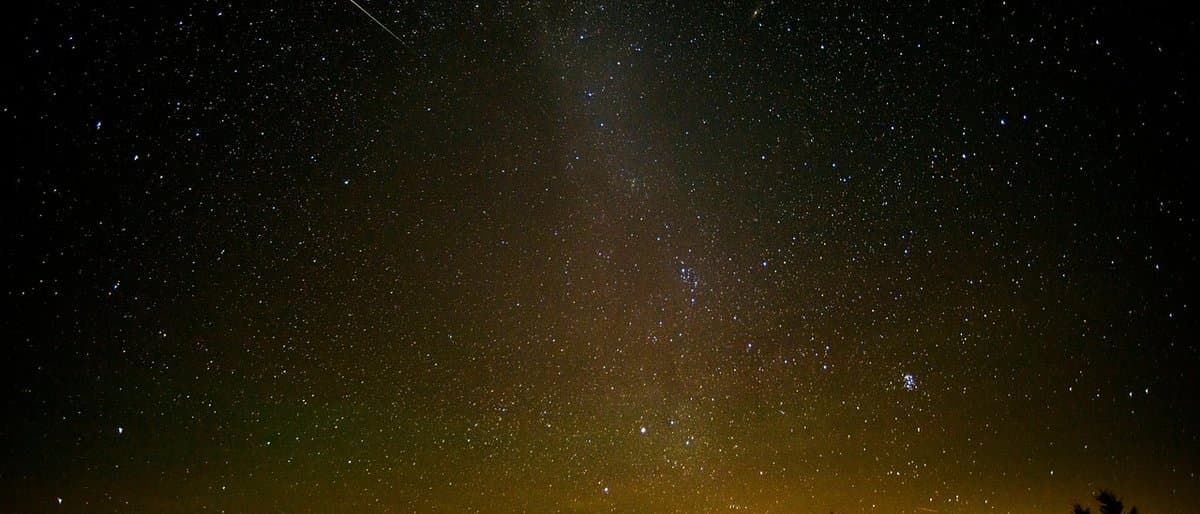
The Orionid meteor shower peaks on the night of Wednesday, October 21 into the early hours of Thursday, October 22, 2026. Under perfect conditions the Orionids produce 20 to 25 meteors per hour, and every single one of them is a piece of Halley's Comet. But here's the honest part most guides bury in paragraph six: 2026 is a bad moon year for this shower. A waxing gibbous moon, roughly 80% illuminated, will sit in the sky for most of the peak night, which means your realistic viewing window runs from about 3:20 a.m. until dawn twilight, after the moon sets. The shower is still worth your alarm clock. You just need to know when to look, and when not to bother.
Orionid Meteor Shower 2026: Peak Times and Honest Viewing Advice
The Orionid meteor shower peaks on the night of Wednesday, October 21 into the early hours of Thursday, October 22, 2026. Under perfect conditions the Orionids produce 20 to 25 meteors per hour, and every single one of them is a piece of Halley's Comet. But here's the honest part most guides bury in paragraph six: 2026 is a bad moon year for this shower. A waxing gibbous moon, roughly 80% illuminated, will sit in the sky for most of the peak night, which means your realistic viewing window runs from about 3:20 a.m. until dawn twilight, after the moon sets. The shower is still worth your alarm clock. You just need to know when to look, and when not to bother.
That's the short version. The full version, including a smarter moon-dodging strategy, where the meteors actually come from, and what you'll realistically see, is below. If you're plotting your whole autumn of sky-watching, our 2026 meteor shower calendar has every shower of the year ranked by moonlight, and the Perseid guide covers the summer's flagship shower.
You're Watching Halley's Comet Burn
The Orionids have the best origin story of any annual meteor shower. Halley's Comet, the most famous comet on Earth, swings around the sun every 76 years or so, and each pass it sheds a trail of dust, grit, and pebble-sized debris along its orbit. That debris stays in place for centuries. Every October, Earth plows straight through the stream, and the particles hit our atmosphere at 66 kilometers per second, about 148,000 mph, fast enough to make the air itself glow.
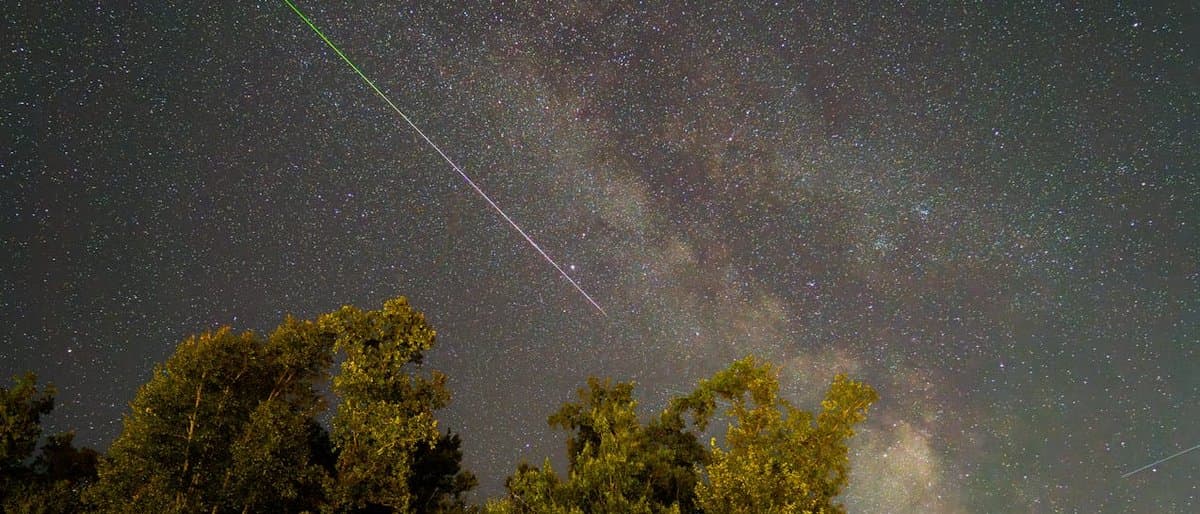
What you're seeing is not the comet and not burning objects in the ordinary sense. Each Orionid is a grain of Halley debris, usually no bigger than a pea, vaporizing 80 kilometers above your head at hypersonic speed. Because they hit so fast, Orionids are among the best meteors of the year for persistent trains, glowing trails of ionized air that hang in the sky for a second or several after the meteor is gone. Occasionally the shower throws a genuine fireball. If you were born after 1986, or you missed Halley's last appearance that year, this October sky is your consolation prize: the comet itself won't return until 2061, but its debris delivers every spring and fall. (Earth crosses Halley's stream twice, the May Eta Aquariids are the other crossing.)
The shower is officially active from October 2 through November 7, so Orionids appear all month at low rates. The peak, when Earth passes through the densest part of the stream, arrives on the night of October 21-22, 2026, with the best activity traditionally in the hours before dawn, when the radiant is highest.
Meet the Parent: Halley's Comet, 1986 to 2061
Halley's Comet itself is on a 75-to-79-year orbit, and it holds the distinction of being the first comet anyone realized returns. Chinese court astronomers recorded it as early as 240 BC; it appears embroidered onto the Bayeux Tapestry above the events of 1066; and in 1705 Edmond Halley worked out that the comets of 1531, 1607, and 1682 were one and the same object, predicting its return for late 1758. He didn't live to see it arrive on Christmas Night that year, and history stamped his name on it instead.
The comet's most recent visit, the perihelion of 1986, was famously unfavorable, Earth and Halley sat on opposite sides of the sun at closest approach, leaving backyard skywatchers a faint smudge. Science got the better view: the European Space Agency's Giotto probe flew within about 600 kilometers of the nucleus in March 1986, imaging a dark, peanut-shaped body roughly 15 by 8 kilometers and confirming that the famous snowball is mostly black crust. The next perihelion falls on July 28, 2061, and this time the geometry cooperates, the comet swings around the sun on the same side of the sky as Earth, and early predictions suggest a noticeably better display for the Northern Hemisphere than 1986's.
The debris connection deserves one more layer of precision. The Orionids and their spring sibling, the Eta Aquariids of early May, are dust from different layers of the same orbit, material Halley shed on separate ancient passes, strung out along its entire path like a river of grit. Earth crosses that river at two points; October's crossing is the one that puts the radiant in Orion, high and convenient for northern observers. Every Orionid you have ever seen has been waiting in that stream for decades or centuries for its two-second appointment with the atmosphere.
The 2026 Moon Problem, Quantified
Let's put numbers on the problem, because "the moon interferes" can mean anything from minor inconvenience to total washout. On October 21, 2026, the moon is 74% illuminated; by the 22nd it's 83%. It's a waxing gibbous building toward the full Hunter's Moon of October 26, and it will be up all evening and well past midnight. From mid-northern latitudes, moonset on the peak night falls at roughly 3:15 to 3:30 a.m. local time, computed, not estimated.
So the peak night splits into two very different experiences. From dusk until about 3 a.m., you'll have a bright moon drowning out all but the brightest Orionids; expect a meteor every 10 or 15 minutes at best, mostly near the moon-washed horizon. From roughly 3:20 a.m. until dawn twilight begins around 5:45 to 6:00 a.m., the sky goes properly dark, the radiant in Orion is near its highest point of the night, and the shower runs at full strength. That 2 to 2.5 hour window is the real show in 2026.
Does the moon ruin the shower entirely? No, and it's worth being precise about why. Moonlight brightens the sky background, which erases faint meteors but doesn't touch the bright ones. In a dark post-moonset window, a patient observer can still catch something like 5 to 10 Orionids per hour, plus whatever fireballs the shower generously drops. What the moon does ruin is the casual evening version of the event, the "lie on a blanket at 10 p.m. with the kids" plan. In 2026, that plan fails.
The Smarter Play: Beat the Moon With Early Mornings
Here's the strategy most coverage won't give you. The Orionids' broad activity means the shower is nearly as strong several nights before the peak, and the moon cooperates much better then. First quarter moon arrives on October 18 at 16:13 UTC. On the mornings of October 17, 18, and 19, the moon is a waxing crescent that sets much earlier: around 11:00 p.m. on the 17th, and just after midnight on the 18th. On those mornings, the sky is fully dark from roughly midnight or 12:30 a.m. until dawn.
The trade-off is simple. On October 17-19, you get a longer dark window (4 to 5 hours instead of 2), but the radiant sits lower in the pre-dawn hours and hourly rates run somewhat below peak. On October 21-22, you get maximum rates but a compressed post-moonset window. Our advice: if you're a casual watcher, try the morning of Sunday, October 18, dark from midnight, decent rates, no 3 a.m. commitment on a work night. If you're a completionist, set the alarm for 3:15 a.m. on Thursday, October 22, the moment the moon abandons the sky.
Either way, the technique matters more than the date. Give your eyes a full 20 to 30 minutes to adapt to darkness, that single step roughly doubles the meteors you'll see. Keep the phone in your pocket; one glance at a bright screen resets your night vision and your clock starts over.
Find your moon-free viewing window
The expected maximum is around October 21-22, 2026. Choose a city and evening to see when the moon leaves the sky before dawn.
Moon-free predawn interval
3:12 AM EDTto5:43 AM EDT
New York, October 22, 2026. About 2 hours 31 minutes.
Moonset
3:12 AM EDT
Oct 22
Astronomical dawn
5:43 AM EDT
Oct 22
Moon at local midnight (Oct 22, 12:00 AM EDT): 81.8% illuminated, Waxing.
Approximate radiant altitude at interval start: 54°.
Moon-free is not a clear-sky forecast. Cloud and light pollution still matter.
JPL DE421/Skyfield estimates for city-centre coordinates and a level horizon. Moonset uses -0.81 degrees; astronomical dawn uses the Sun at -18 degrees. Illumination is computed at local midnight.
Where to Look: Orion's Club, Not Orion's Belt
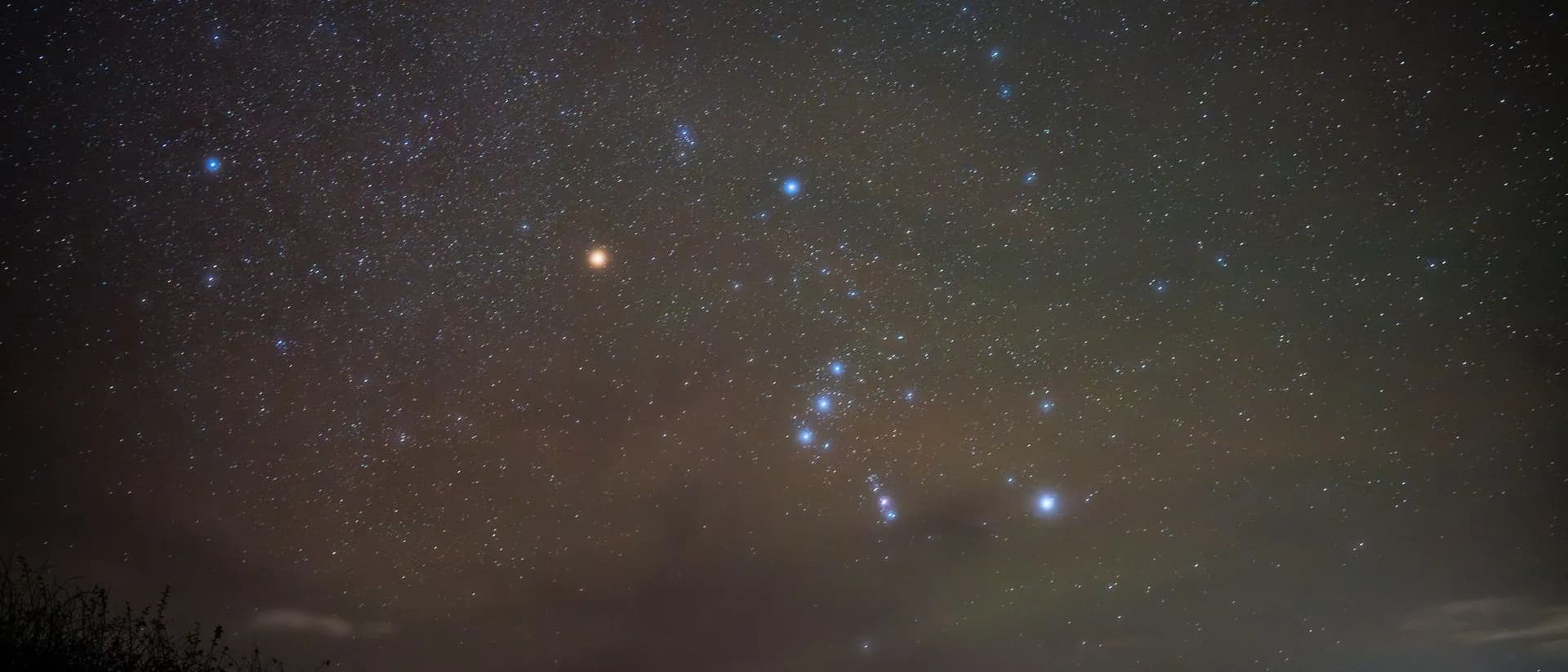
The shower's radiant, the point the meteors appear to streak outward from, sits in the top of constellation Orion, near the border with Gemini, above the bright orange star Betelgeuse. From mid-northern latitudes, this part of the sky climbs over the eastern horizon around 10:30 p.m. local time and reaches its highest point in the south just as morning twilight begins. That height is why pre-dawn hours are always the best for this shower: the higher the radiant, the more of the shower's meteors clear your horizon.
But here's the thing beginners get wrong: do not stare at the radiant. Meteors near their radiant point have short, stubby trails, the geometry works against you. The best Orionids appear 40 to 90 degrees away from the radiant, streaking long across the sky. Lie back in a reclining chair or on a blanket, point your feet roughly toward the east or southeast, and take in as much sky as possible. Your peripheral vision is your meteor detector; give it the whole dome to work with.
No telescope, no binoculars, this is a wide-field, naked-eye event by design. The only gear worth bringing is a reclining chair so your neck survives, a blanket rated for October temperatures, and a red-light flashlight if you need to check a star chart. Every one of these meteor-watching basics applies to the bigger showers too, the best stargazing nights of 2026 guide runs through the full kit.
Finding Orion in Five Minutes
Even if you've never knowingly found Orion, you can do it in about five minutes, and October's pre-dawn sky is the perfect classroom. Face east to southeast after 10:30 p.m. and look for three bright stars in a straight, evenly spaced line, Orion's belt, the single most recognizable star pattern in the sky. Once you have the belt, the rest of the constellation snaps into place around it: a bright orange star up and to the left is Betelgeuse, the hunter's shoulder; a brilliant blue-white star down and to the right is Rigel, his foot; and four fainter stars trace the shoulders and knees of a giant hourglass.
The two anchor stars are worth knowing on their own terms. Betelgeuse is a red supergiant, a dying star swollen to hundreds of times the sun's diameter and shining on the order of 100,000 times brighter. Its distance is still debated (modern estimates range from roughly 400 to 700 light-years), and the star is famously moody: in late 2019 and early 2020 it dimmed by about 60 percent, triggering worldwide "is it about to explode?" coverage before astronomers showed the culprit was a cloud of dust the star had burped off its own surface. Betelgeuse will eventually detonate as a supernova, on astronomical timescales, meaning any night between now and 100,000 years from now, and when it goes, it will briefly rival the full moon.
Rigel is the opposite kind of giant: a blue supergiant some 860 light-years out and roughly 120,000 times the sun's luminosity, the most powerful star in its whole corner of the sky. Between them, the belt points down and to the left toward Sirius, the brightest star in the night sky, and up and to the right toward Aldebaran, the orange eye of Taurus. The Orionid radiant sits just above Betelgeuse near the border with Gemini, find the orange shoulder star and you're looking within a few degrees of the spot every October meteor appears to come from.
What You'll Realistically See
Set expectations now and you won't be disappointed at 4 a.m. The International Meteor Organization's standard figure for the Orionids is a zenithal hourly rate of about 20-25, that's an ideal-sky, radiant-overhead, eagle-eyed-observer number that no real human experiences. NASA's more grounded field estimate for the Orionids is 10 to 20 meteors per hour under dark skies. With 2026's moon in the first part of the night and the compressed dark window on peak night, a realistic suburban expectation is a meteor every 6 to 10 minutes in the post-moonset hours; from a genuinely dark rural site, closer to one every 4 or 5 minutes.
What the Orionids lack in raw numbers they return in quality. The 66 km/s entry speed makes them fast, crisp streaks, noticeably quicker than the August Perseids' 59 km/s, and a fair fraction leave those prized persistent trains. Occasionally one of them arrives as a genuine fireball, briefly brighter than the planet Venus. The shower has a documented habit of surprise, too: in 2006 and through the late 2000s, observers caught unexpected outbursts of 50-70 meteors per hour. Nobody has ever found a way to predict those years in advance, which is as good a reason as any to check the sky more than once.
Hemisphere notes: the Orionids are visible from both hemispheres, but the north has the geometric edge, the radiant climbs higher, and October nights are longer. From the Southern Hemisphere the shower is visible in the northern sky before dawn at reduced rates, and your spring evenings are considerably warmer, which counts for something at 4 a.m. For the general reason a published rate and your own count differ, see what the hourly meteor rate actually means.
Photographing the Orionids
Meteor photography is luck management, and the 2026 moon window makes planning matter more than usual. The core recipe: a wide, fast lens (14-24mm at f/2.8 or brighter), the camera in full manual, and a continuous run of 15-25 second exposures at ISO 3200-6400. Focus is the step everyone gets wrong, autofocus hunts helplessly in the dark, so switch to manual, use live-view magnification on a bright star to nail it, and then leave the ring alone. Fire up an intervalometer or a locked cable release and let the camera run through the entire dark window; a two-hour session at 20 seconds per frame produces roughly 360 frames, of which a handful may hold a meteor.
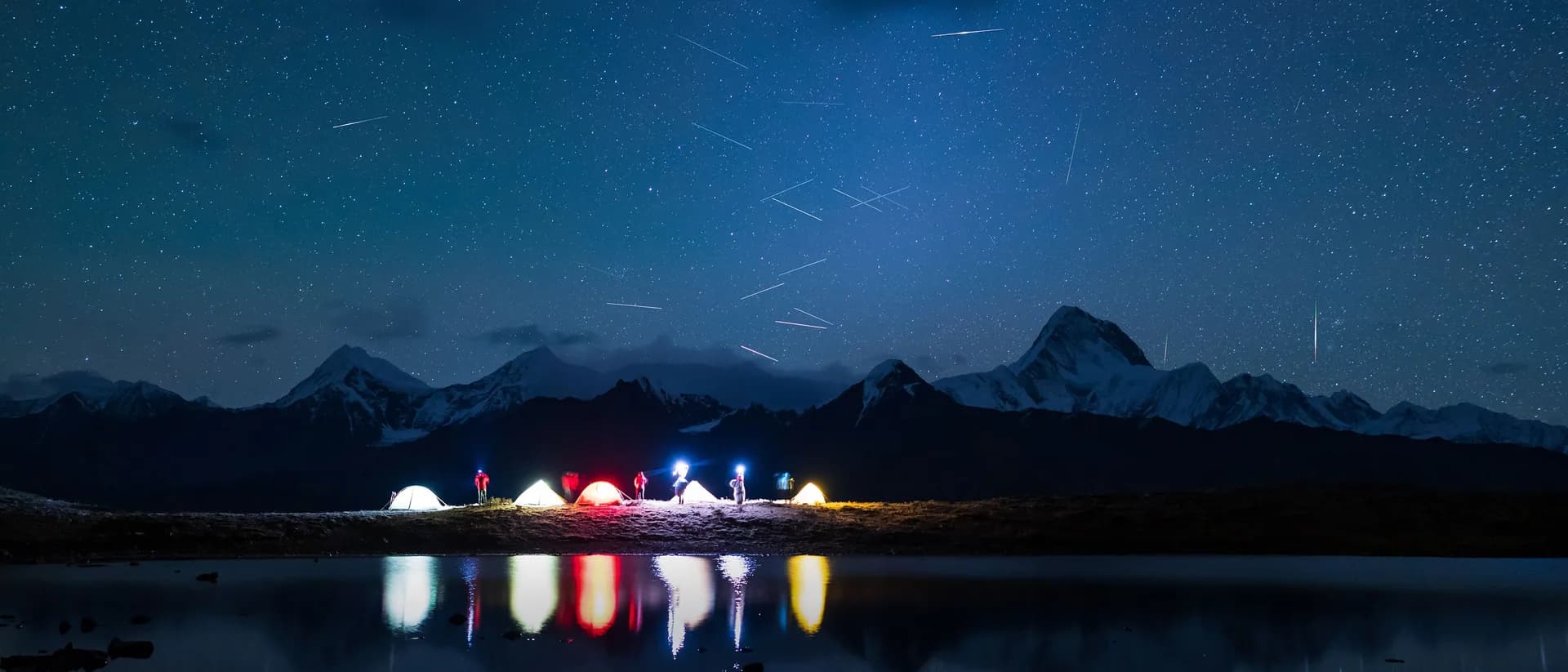
Composition matters as much as settings. Frame 40 to 60 degrees away from the radiant, the same geometry that shows watchers the longest meteors gives the camera the longest trails. Including a foreground, whether a treeline, a ridgeline, or a tent with a light inside, converts a lucky streak into a photograph; a meteor in a featureless starfield is data, not a picture. To keep stars sharp, respect the 500 rule: divide 500 by your focal length (500 ÷ 20mm = 25 seconds) and keep exposures under that number, or the stars begin to smear into trails of their own.
The honest odds: most meteor photography is time-lapse of nothing, punctuated by shrieking. Even at the Orionids' peak, a single 20-second frame carries maybe a 1-in-20 chance of catching a bright meteor. The 2026 dark window, roughly 3:20 a.m. until dawn, allows only a few hundred frames per night, so bring more battery than feels reasonable, because cold October air drains cells early. The consolation: every technique here transfers unchanged to the Geminids in December, where the hourly rates, and your hit rate, run five times higher.
After the Orionids: Taurids, Leonids, and the Main Event
The calendar doesn't stop in October. The Taurids (early-to-mid November) are a slow, sparse shower famous for fireballs rather than counts, and they tolerate moonlight better than most. The Leonids peak around November 17-18, 2026, with a first-quarter moon setting around midnight, a decent but not great year for them.
The one to circle is the Geminid meteor shower on December 13-14, 2026. It's the strongest shower of the year, and in 2026 the moon is a thin crescent that sets by 9 p.m., leaving the entire night dark. If the Orionids' moon frustrates you in October, consider it a rehearsal: same technique, better hours, five times the meteors. And if you're planning around specific dates, our calendar tool plots every one of these events alongside holidays and time changes, which is handy in a season when clocks move in half the world's countries.
Orionid Peaks and Moon Conditions, 2026-2030
The Orionid peak lands within a day or two of October 21 every year, the exact best night shifts slightly, and moon conditions swing wildly. Here's the computed outlook, so you can plan more than one autumn ahead:
| Year | Peak Night (approx.) | Moon at Peak | Verdict |
|---|---|---|---|
| 2026 | Oct 21-22 | ~74-83% waxing gibbous | Tough, post-moonset window only |
| 2027 | Oct 21-22 | ~55-66% waning gibbous | Moon up after mid-evening; early evening fair |
| 2028 | Oct 20-21 | ~14-22% waxing crescent | Excellent, thin crescent sets by mid-evening |
| 2029 | Oct 21-22 | ~99% full moon | Washed out, skip it |
| 2030 | Oct 21-22 | ~25-34% waning crescent | Modest, crescent rises after midnight |
Two patterns worth knowing. First, when the Orionids get a moonless year, as in 2028, they're one of the most reliable mid-size showers in the sky, and the pre-dawn hours deliver their full 20-25 per hour. Second, avoid the full-moon years: 2029's Orionids land within a day of a full moon, making that peak a near-total washout. The moon's 19-year phase cycle (the Metonic cycle) means the 2026 interference pattern repeats roughly in 2045; if you're the long-game type, that's your next comparably stubborn Orionid year.
Explore More
- Geminid Meteor Shower 2026, the year's best shower with moonless December skies; the Orionids are your warm-up act
- Meteor Showers 2026: The Full Calendar, every shower of the year, ranked, with moon conditions
- Perseid Meteor Shower 2026, the August classic, for planning next summer
- Best Stargazing Nights 2026, the master calendar of dark-sky nights for the whole year
- Moon Phases 2026, because every meteor shower's fate comes down to the moon
Frequently Asked Questions
5 questions answered
When is the peak of the Orionid meteor shower in 2026?
Why are the Orionids connected to Halley's Comet?
How many Orionid meteors will I see per hour in 2026?
Where should I look to see the Orionids?
Should I use a telescope or binoculars for the Orionids?
Put this into action
Stop guessing. Use our professional tools to schedule, convert, and manage time zones perfectly, 100% free.
Track Sky EventsOfficial Sources & References
- NASA Science: official data and scientific overviews for astronomical events and missions.