Comet 2026: Visible Comets & How to See Them
Quick Answer
2026 is not a great year for bright naked-eye comets. The best currently-observable comet is 10P/Tempel 2, visible in July to August at magnitude 10 to 11 (telescope required).** The next reasonable chance for a brighter comet is 2P/Encke, which reaches perihelion around January 2027 and may become binocular-visible in late 2026. The most-publicized comet of early 2026, C/2024 E1 (PanSTARRS), has already passed its peak and faded. Comet predictions are notoriously unreliable: be skeptical of hype, but be ready to observe when a comet does perform.
2026 is not a great year for bright naked-eye comets. The honest truth is that most comets visible this year require binoculars or a small telescope, and the most-publicized comet of early 2026 (C/2024 E1 PanSTARRS) has already passed its peak and faded. The best currently-observable comet is 10P/Tempel 2, visible in the evening sky from July through August 2026 at magnitude 10 to 11 (telescope required). The next reasonable chance for a brighter comet is 2P/Encke, which reaches perihelion around January 2027 and may become visible in late 2026. Newly-discovered C/2026 A1 (MAPS) is being tracked but its brightness trajectory is uncertain.
This is the honest framing most astronomy sites will not give you. Comet predictions are notoriously unreliable. Comets have been hyped as "comet of the century" and then fizzled (Kohoutek in 1973, ISON in 2013), and faint comets have unexpectedly flared into brilliance (NEOWISE in 2020 was a wonderful surprise). What we can tell you with confidence is which comets are currently visible, what equipment you need to see them, and how to track them. We will also tell you when to expect the next chance for a bright comet, and we will be honest about how unpredictable that timing is.
For the dark-sky planning that comet observation requires, see our moon phases 2026 page.
The Honest Truth About Comets in 2026
Here is what is actually visible, with honest equipment requirements:
Currently visible (July 2026):
- 10P/Tempel 2: visible in the evening sky from July through August 2026. Magnitude around 10 to 11, which means a telescope of at least 4 to 6 inches (100 to 150mm) aperture is required to see it as a faint fuzzy patch. Not a naked-eye comet, but a known periodic comet (orbital period ~5.4 years) that experienced observers can track. Located in the constellation Scorpius in July, moving into Sagittarius in August.
- C/2024 E1 (PanSTARRS): passed perihelion (closest to the Sun) around April 19, 2026. Was visible in early 2026 at around magnitude 9 to 10 (binoculars required) but has now faded to magnitude 12+ as it moves away from the Sun. Essentially requires a telescope to observe. Visible in the morning sky before dawn, moving through Virgo.
Upcoming in late 2026:
- 2P/Encke: next perihelion expected around January 2027. May become visible in late 2026 as it approaches the Sun, potentially reaching magnitude 7 to 8 (binoculars required). Encke has the shortest known orbital period of any comet, 3.3 years, so it returns frequently, but it is also a small comet that does not get very bright. Watch for updates from comet observers as autumn 2026 progresses.
- C/2026 A1 (MAPS): a newly discovered comet announced in early 2026. Brightness trajectory is uncertain; early estimates suggested possible naked-eye visibility, but comets are unpredictable and the estimate may be revised. Check current brightness estimates from sources like the Minor Planet Center or comet observation mailing lists before planning to observe.
The honest summary: If you want to see a comet in 2026, you will almost certainly need binoculars or a small telescope. There is no currently-predicted naked-eye comet for the rest of 2026. The next realistic chance for a naked-eye comet is unpredictable: it could be Encke in late 2026 (probably not naked-eye, but binocular-bright), or it could be a newly-discovered comet that appears with just weeks of warning.
For the moon-phase planning that matters for faint comet observation, see our moon phases 2026 page.
Comet vs Meteor: The Common Confusion
People constantly confuse comets and meteors, and the confusion is understandable. Both are space rocks, both involve the word "shooting" in casual usage, and both appear in the sky. But they are completely different phenomena, and understanding the difference is essential for anyone interested in observing either.
A comet is a solid body made of ice, dust, and rocky material, typically 1 to 10 km across, orbiting the Sun in a long elliptical orbit. Most comets originate in the Kuiper Belt (beyond Neptune) or the Oort Cloud (far beyond Pluto). When a comet's orbit brings it close to the Sun, the Sun's heat vaporizes the ices, releasing gas and dust that form a glowing "coma" (a fuzzy atmosphere around the solid nucleus) and a "tail" that streams away from the Sun. A comet is visible for weeks or months as it moves slowly across the sky. Comets are large objects; even a small comet is kilometers across, but they are very far away (typically tens of millions of kilometers from Earth at closest approach).
A meteor is a tiny grain of dust or rock, typically the size of a grain of sand, burning up in Earth's atmosphere. Meteors are not solid objects in space; they are the visible streak of light produced when a tiny particle enters Earth's atmosphere at high speed (typically 11 to 72 km/s) and is vaporized by friction. A meteor is visible for a fraction of a second to a few seconds. Most meteors are sporadic (random), but during meteor showers, Earth passes through a stream of debris left by a comet (or occasionally an asteroid), producing many meteors that appear to radiate from a single point in the sky. Meteors are tiny (a grain of sand) but they are very close (50 to 100 km above Earth's surface).
The connection: Comets and meteors are related. As a comet orbits the Sun and releases dust, that dust spreads out along the comet's orbit. When Earth passes through this dust stream, the particles enter our atmosphere and become meteors. Every meteor shower is associated with a parent comet (or sometimes an asteroid). The Perseids are caused by dust from Comet Swift-Tuttle. The Leonids are caused by dust from Comet Tempel-Tuttle. The Geminids are caused by dust from the asteroid 3200 Phaethon (an unusual case of an asteroid producing a meteor shower).
So when you see a "shooting star" (a meteor), you are seeing a tiny piece of dust from a comet (or asteroid) burning up in our atmosphere. When you see a comet (with binoculars or telescope, in 2026), you are seeing the parent body that produced (or will produce) the dust stream that creates a meteor shower.
For the meteor shower calendar, which lists the meteor showers produced by various comets, see our meteor showers 2026 page.
How Comets Work: The Science
A comet is essentially a "dirty snowball," a small body of ice, dust, and rocky material left over from the formation of the solar system 4.6 billion years ago. Comets formed in the cold outer solar system, beyond the "frost line" where ices could survive, and they have spent most of the solar system's history in deep freeze in the Kuiper Belt or Oort Cloud. When gravitational perturbations (from passing stars, giant molecular clouds, or the gravity of the giant planets) push a comet into a new orbit that brings it close to the Sun, the comet "wakes up" and becomes visible.
The structure of a comet:
- Nucleus: the solid, icy core of the comet. Typically 1 to 10 km across, made of water ice, frozen gases (carbon dioxide, carbon monoxide, methane, ammonia), and rocky dust. The nucleus is the only part of the comet that exists when it is far from the Sun. The European Space Agency's Rosetta mission orbited Comet 67P/Churyumov-Gerasimenko's nucleus from 2014 to 2016, returning the first detailed images of a comet nucleus up close.
- Coma: the fuzzy atmosphere that surrounds the nucleus when the comet is close to the Sun. The coma is produced when solar heat vaporizes the ices, releasing gas and dust. The coma can be 100,000+ km across, larger than the Earth, even though the nucleus is only a few kilometers across.
- Tail: the most distinctive feature of a bright comet. There are actually two tails, which point in slightly different directions:
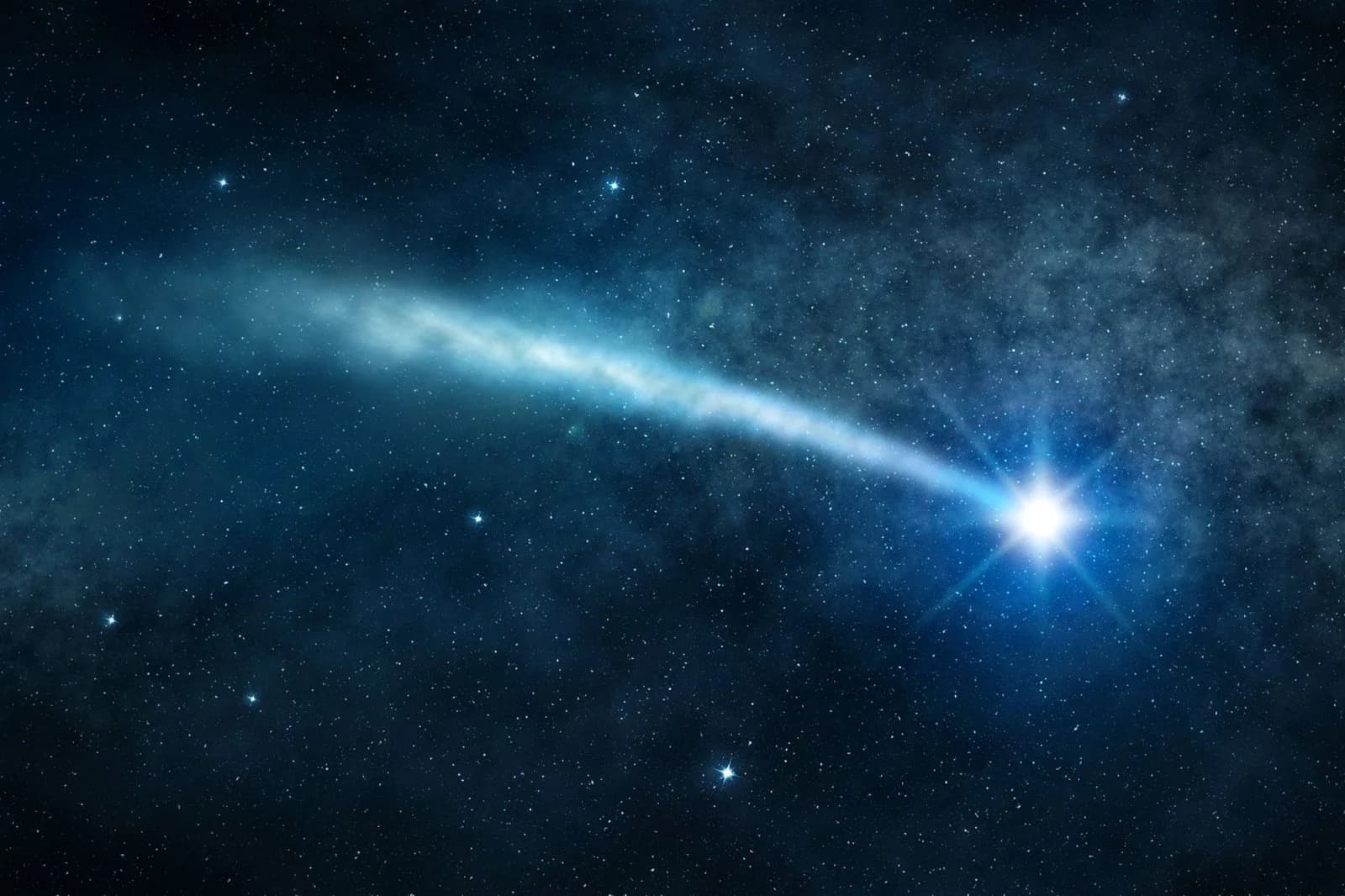
- Ion tail (also called the gas tail or plasma tail): made of ionized gas (charged particles). Blue in color. Always points directly away from the Sun, regardless of the comet's direction of motion. Pushed by the solar wind (the stream of charged particles flowing from the Sun). Can be straight and narrow, extending millions of kilometers into space.
- Dust tail: made of microscopic dust particles released from the nucleus. White or yellowish in color. Curves away from the Sun in a gentle arc, pushed by solar radiation pressure (sunlight). The dust tail follows the comet's orbit more closely than the ion tail, producing the curved "scimitar" shape familiar from comet photographs.
Why comet brightness is unpredictable: Comets brighten as they approach the Sun (more heat = more vaporization = more coma and tail), but the rate of brightening depends on the comet's composition, rotation, and surface features. Some comets brighten predictably; others have sudden outbursts or unexpected fadings. A comet that appears promising at magnitude 12 when discovered may fizzle as it approaches the Sun, or it may flare dramatically. This is why comet predictions are hedged with uncertainty. Anyone who tells you a comet will definitely reach a specific magnitude is being dishonest.
The famous Comet Kohoutek of 1973 was hyped as potentially the "comet of the century," but it fizzled dramatically as it approached the Sun, disappointing millions of observers. Comet ISON in 2013 was similarly hyped and similarly fizzled; it disintegrated as it passed perihelion. Conversely, Comet NEOWISE in 2020 was a surprise, discovered only a few months before it became a spectacular naked-eye object. The lesson is: be skeptical of comet hype, but be ready to observe when a comet does perform.
For the dark-sky calendar that matters for comet observation, see our moon phases 2026 page.
How to Find and Observe a Comet
Finding a comet requires more preparation than finding a planet or a bright star. Comets are faint, fuzzy, and move slowly across the sky from night to night. Here is the process:
Step 1: Get current orbital information. Comet positions change nightly. The authoritative source is the Minor Planet Center (minorplanetcenter.net), which publishes daily positions for all observable comets. The Sky & Telescope and EarthSky websites also publish monthly comet observing guides with current positions and brightness estimates.
Step 2: Use a star chart or astronomy app. Once you have the comet's current position (Right Ascension and Declination), you need to find that position in the sky. Apps like Stellarium, SkyView, and Star Walk can show comet positions in real time. For manual finding, you need a detailed star chart showing stars down to at least magnitude 8 (fainter than the comet, so you can use the stars as a "path" to the comet's location).
Step 3: Find a dark sky location. Comets are faint; even a "bright" comet at magnitude 7 is invisible from a city. You need a dark sky location (Bortle class 3 or better) for any comet observing. Check the Bortle class of your intended location on lightpollutionmap.info.
Step 4: Acclimate your eyes to the dark. It takes 20 to 30 minutes for your eyes to fully dark-adapt. Avoid white light (including phone screens) during this period. Use only a red flashlight. Fully dark-adapted eyes are 50 to 100x more sensitive than eyes that have just been exposed to white light.
Step 5: Use averted vision. The center of your retina is optimized for bright light and color; the edges are optimized for low light. When looking for a faint comet, look slightly to the side of where the comet should be. The comet will appear brighter to your averted (edge) vision than to your direct vision. This is a real, physiological effect, and it makes a dramatic difference for faint object observing.
Step 6: Look for a fuzzy patch, not a point. Comets do not look like stars (which are points of light). A comet looks like a small fuzzy patch, like a tiny cloud or a piece of cotton ball. The coma is the fuzzy center; the tail (if visible) extends from the coma in one direction. Once you know what to look for, comets are easier to spot, but the first time you see one, it can be surprisingly difficult to distinguish from a faint star cluster or a distant galaxy.
For the broader astronomy calendar, see our best stargazing nights 2026 page.
Comet 10P/Tempel 2: The Best Currently Observable Comet
Comet 10P/Tempel 2 is the best comet currently observable from mid-northern latitudes (as of July 2026). Here is what you need to know:
Discovery and history: Tempel 2 was discovered by Ernst Tempel on July 4, 1873, from Milan, Italy. It is a Jupiter-family comet with an orbital period of about 5.4 years, meaning it returns to perihelion (closest approach to the Sun) every 5.4 years. The 2026 apparition is one of the better ones; the comet is favorably placed in the evening sky during July and August.
Position and visibility (July to August 2026):
- Early July 2026: in the constellation Scorpius, low in the southern sky after sunset. Magnitude around 10.5.
- Late July 2026: moving into Sagittarius, slightly higher in the sky. Magnitude around 10.0.
- Early August 2026: in Sagittarius, near the "teapot" asterism. Magnitude around 10.5, fading.
- Late August 2026: in Sagittarius, fading to magnitude 11+. Becoming difficult to observe.
Equipment required: a telescope of at least 4 to 6 inches (100 to 150mm) aperture. In a 6-inch telescope, Tempel 2 appears as a small fuzzy patch of light, perhaps 2 to 3 arcminutes across (about 1/20 the diameter of the full moon). No tail is visible in amateur telescopes. Tempel 2 is a small comet that does not produce a prominent tail.
How to find it: use a detailed star chart showing stars down to magnitude 11. Find the comet's current position (Right Ascension and Declination) from the Minor Planet Center or Sky & Telescope. Center your telescope on the nearest bright star, then "star hop" to the comet's position using the star chart as a guide. The comet will appear as a faint fuzzy patch that does not match any of the stars on your chart.
For comparison with another famous periodic comet, see our Perseid meteor shower 2026 page. The Perseids are caused by dust from Comet Swift-Tuttle, which is one of the largest comets known and would be spectacular if it ever passed close to Earth.
Comet 2P/Encke: The Late 2026 Prospect
Comet 2P/Encke is the next reasonable prospect for comet observers, with perihelion expected around January 2027. Encke may become visible in late 2026 as it approaches the Sun.
Discovery and history: Encke was first observed in 1786 by Pierre Méchain, but it was Johann Franz Encke who in 1819 calculated that the comets observed in 1786, 1795, 1805, and 1818 were all the same object returning every 3.3 years. Encke's orbital period of 3.3 years is the shortest of any known comet; it has been observed at more than 60 perihelion passages since discovery.
Visibility prospects for late 2026: Encke will be approaching the Sun in autumn 2026, brightening as it gets closer. Current predictions suggest it may reach magnitude 7 to 8 in late November and December 2026, which would make it visible in binoculars from a dark sky location. Encke will be in the morning sky before dawn, moving from Leo toward Virgo.
Equipment required (predicted): binoculars (10x50 or larger) at minimum. A small telescope will give a better view. Encke is a small comet that does not produce a prominent tail, but the coma should be visible as a fuzzy patch.
Caveat: Comet predictions are uncertain. Encke may brighten more or less than predicted. Check current brightness estimates from sources like COBS (Comet Observers Database) or the Minor Planet Center before planning to observe.
Comet C/2024 E1 (PanSTARRS): The Recent Fading Comet
Comet C/2024 E1 (PanSTARRS) was the most-publicized comet of early 2026, but it has now faded significantly. Here is the recent history for context:
Discovery: C/2024 E1 was discovered by the Pan-STARRS 1 telescope on March 1, 2024. Early orbital calculations suggested it would reach perihelion (closest approach to the Sun) in April 2026 at a distance of about 0.8 AU from the Sun. Brightness predictions varied, but some estimates suggested it could reach magnitude 8 to 9 (binocular visibility).
Peak and fading: the comet reached perihelion around April 19, 2026. It did brighten to around magnitude 9 to 10 (binocular visibility from a dark sky), but it did not become a naked-eye object. As of July 2026, the comet has moved well away from the Sun and faded to magnitude 12+, making it a telescope-only object.
Current visibility (July 2026): visible in the morning sky before dawn, moving through the constellation Virgo. Magnitude 12+, requiring at least a 6 to 8 inch telescope to observe. Essentially of interest only to dedicated comet observers.
Lesson: C/2024 E1 was a typical comet. It brightened modestly as it approached the Sun, did not become a naked-eye object, and is now fading. Most comets follow this pattern. The comets that become naked-eye spectacles (NEOWISE in 2020, Hale-Bopp in 1997, Hyakutake in 1996) are rare exceptions.
How to Stay Updated on Comets
Comet astronomy moves fast. A newly-discovered comet can become visible with just weeks of warning, and an existing comet can have an unexpected outburst that makes it briefly bright. To stay updated:
- Minor Planet Center (minorplanetcenter.net): the authoritative source for comet positions and orbital elements. Publishes daily updates.
- EarthSky (earthsky.org): excellent popular-level coverage of comets and other astronomy events. Publishes monthly comet observing guides.
- Sky & Telescope (skyandtelescope.org): long-running astronomy magazine with detailed comet coverage. Their "This Week's Sky" column includes comet updates.
- COBS (Comet Observers Database, cobs.si): a database of comet observations from amateur and professional astronomers worldwide. Real-time brightness estimates from observers.
- Comet mailing lists: the Yahoo "comets-ml" mailing list (now hosted elsewhere) is the primary forum for serious comet observers. Real-time discussion of new discoveries and outbursts.
For meteor showers caused by comet dust, see our meteor showers 2026 page.
The Next Bright Comet: When?
The honest answer: we do not know. Bright naked-eye comets are unpredictable. Some patterns:
- New comets from the Oort Cloud can appear with only months of warning. These are the most likely source of the next "comet of the century," but they are also the most unpredictable. A new comet discovered next month could become visible next year, or it could fizzle.
- Known periodic comets return on predictable schedules, but most are faint. The truly bright periodic comets (like Halley, which returns every 76 years) are rare. Halley's next perihelion is in 2061.
- The recent "bright comet" rate has been about one naked-eye comet per 5 to 10 years. NEOWISE in 2020 was the last truly bright one. The next could be next year, or it could be 2030.
If you want to maximize your chances of seeing a bright comet, the best strategy is to follow the comet observation sources above and be ready to observe quickly when a promising comet is announced. Comets do not wait for convenient scheduling; they brighten and fade on their own schedules, and you have to be ready to drop everything and observe when the time comes.
For the meteor showers that share the same dark-sky windows as comet observing, see our meteor showers 2026 page. For the broader dark-sky calendar, see our best stargazing nights 2026 page.
What to Do Next
If you want to try comet observing in 2026, the realistic plan is: get a telescope (or borrow one), find a dark sky location, get current orbital information for 10P/Tempel 2 from the Minor Planet Center, and try to find it in July or August 2026. The challenge of finding a faint fuzzy patch in a telescope, and the satisfaction of actually locating it, is one of the most rewarding experiences in amateur astronomy. Even if Tempel 2 is not visually spectacular, the act of finding it puts you in a small minority of people who have ever knowingly observed a comet through a telescope.
For the broader astronomy calendar that includes comet-favorable dark-sky windows, bookmark our moon phases 2026 page and our best stargazing nights 2026 page. For the meteor showers that comets ultimately produce, see our meteor showers 2026 page.
Explore More
- 🌑 Moon Phases 2026: the moon-phase calendar that determines when skies are dark enough for comet observing.
- ☄️ Meteor Showers 2026: the meteor showers that comets ultimately produce, with peak dates and viewing guides.
- ☄️ Perseid Meteor Shower 2026: the best meteor shower of 2026, caused by dust from Comet Swift-Tuttle.
- 🔭 Best Stargazing Nights 2026: the master dark-sky calendar for all astronomy observing.
- 🌑 August 12, 2026: Eclipse + Perseids Double Event: the biggest astronomy day of 2026, with a total solar eclipse during the day and the Perseid meteor shower peak that night.
Frequently Asked Questions
5 questions answered
Are there any bright comets visible in 2026?
What is the best comet to observe right now?
What about comet 2P/Encke?
What's the difference between a comet and a meteor?
When is the next bright comet coming?
Put this into action
Stop guessing. Use our professional tools to schedule, convert, and manage time zones perfectly — 100% free.
Track Sky EventsOfficial Sources & References
- NASA Science — Official data and scientific overviews for astronomical events and missions.