Solar Maximum 2026: Why This Is Still the Year of Epic Northern Lights
Quick Answer
Solar maximum was officially reached in 2024 to 2025, but 2026 still sees elevated aurora and frequent KP5+ storms. The decline phase of a solar cycle is statistically when some of the largest individual storms occur, including the famous 1859 Carrington Event. Through the rest of 2026, observers can expect several KP5+ geomagnetic storms per month, with occasional KP7 to KP8 events that push aurora visibility to mid-latitudes. Solar minimum is not expected until around 2030.
Solar maximum, the peak of the Sun's 11-year activity cycle, was officially announced as reached during the 2024 to 2025 period by NASA and NOAA. As of July 2026, we are on the declining side of the cycle, but 2026 still sees elevated solar activity and frequent aurora-producing storms at lower latitudes than usual. The decline phase of a solar cycle is historically when some of the largest individual storms occur, including the famous Carrington Event of 1859. Through the rest of 2026, observers can expect several KP5+ geomagnetic storms per month, with occasional KP7 to KP8 events that push aurora visibility to mid-latitudes (northern US, UK, central Europe). Solar minimum, the next quiet phase, is not expected until around 2030.
This is the companion article to our Northern Lights 2026 guide. That article explains when and where to see aurora; this article explains why aurora is happening in the first place. The two articles are designed to be read together, covering the underlying physics (this page) and the practical viewing guide (the companion page).
For the moon-phase planning that matters enormously for aurora photography, see our moon phases 2026 calendar.
Solar Cycle 25: Where We Are
Solar Cycle 25 began in December 2019, when the Sun's magnetic field reversed polarity and a new cycle of sunspot activity began. Solar cycles last approximately 11 years (the range is 9 to 14 years), and each cycle has a predictable shape: a roughly 4-year rise from minimum to maximum, followed by a roughly 7-year decline from maximum back to minimum. The rise is steeper than the decline; activity builds quickly and falls off slowly.
Cycle 25 has been more active than initially predicted. Early forecasts from 2019 suggested a relatively weak cycle (similar to Cycle 24, which was the weakest in a century), but the actual sunspot counts have significantly exceeded forecasts. By 2024, monthly sunspot numbers were the highest since Cycle 23 peaked in 2000 to 2002. The May 2024 "Gannon storm," a KP9 event that produced aurora visible from Hawaii, Mexico, and northern Africa, was the most powerful geomagnetic storm since the 2003 Halloween storms.
Where we are now (July 2026): Solar maximum was officially declared in late 2024 / early 2025, when sunspot counts and solar flare activity peaked. We are now approximately 18 months past the peak, in the early decline phase. The decline phase typically lasts 5 to 7 years, with activity falling off gradually. The decline is not a smooth curve. There are spikes of high activity even as the overall trend is downward. 2026 falls in a particularly interesting window: activity is lower than the absolute peak, but still high enough that major storms occur regularly.
The practical implication: 2026 is not the best year of the solar cycle for aurora (that was 2024), but it is still a significantly better year than the average year. Aurora at mid-latitudes (the northern US, the UK, central Europe) will be visible multiple times in 2026, far more often than during solar minimum years. If you have been waiting to see aurora from unusual latitudes, 2026 is still a good year, and 2027 will be a slightly lesser version of 2026.
For the broader astronomy calendar that complements aurora season, see our meteor showers 2026 page.
What Solar Maximum Actually Means: In Plain Language
The Sun is not a steady lightbulb. It is a giant ball of plasma (ionized gas) with a complex, constantly-changing magnetic field. This magnetic field is generated by the movement of charged particles inside the Sun, a process called the solar dynamo. The dynamo is driven by the Sun's rotation and by convection (hot plasma rising, cooling, and sinking). Because the Sun is not a solid body, different parts rotate at different speeds. The equator rotates faster than the poles. This "differential rotation" twists and stretches the magnetic field over time, building up stress.
Every 11 years, the magnetic field becomes so twisted and stressed that it reorganizes itself. The north magnetic pole becomes the south magnetic pole, and vice versa. This magnetic flip is what defines a solar cycle. During the period around the flip (solar maximum) the magnetic field is at its most chaotic. This chaos produces:
- More sunspots: dark, cooler patches on the Sun's surface where the magnetic field is particularly strong. Sunspot count is the traditional measure of solar activity. During solar minimum, the Sun may have zero sunspots for weeks at a time. During solar maximum, the Sun typically has 100 to 200+ sunspots visible at once.
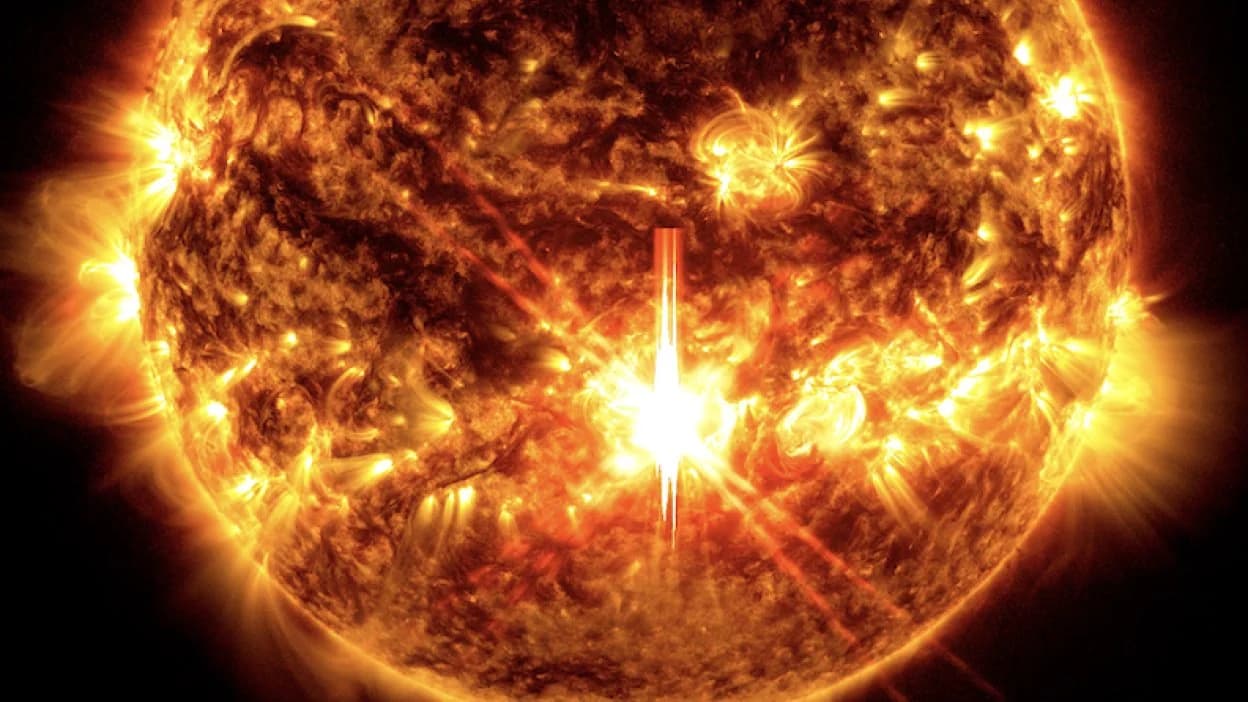
- More solar flares: sudden flashes of electromagnetic radiation (mostly X-rays and ultraviolet) released when the magnetic field reconfigures itself. Flares are classified by strength: A, B, C, M, X (in increasing order). Each letter is 10 times stronger than the previous. X-class flares are the most powerful and occur most frequently during solar maximum.
- More coronal mass ejections (CMEs): enormous eruptions of plasma and magnetic field from the Sun's corona (outer atmosphere). A typical CME carries billions of tons of material at millions of kilometers per hour. CMEs are the primary cause of geomagnetic storms on Earth. When a CME hits Earth's magnetic field, it triggers the aurora.
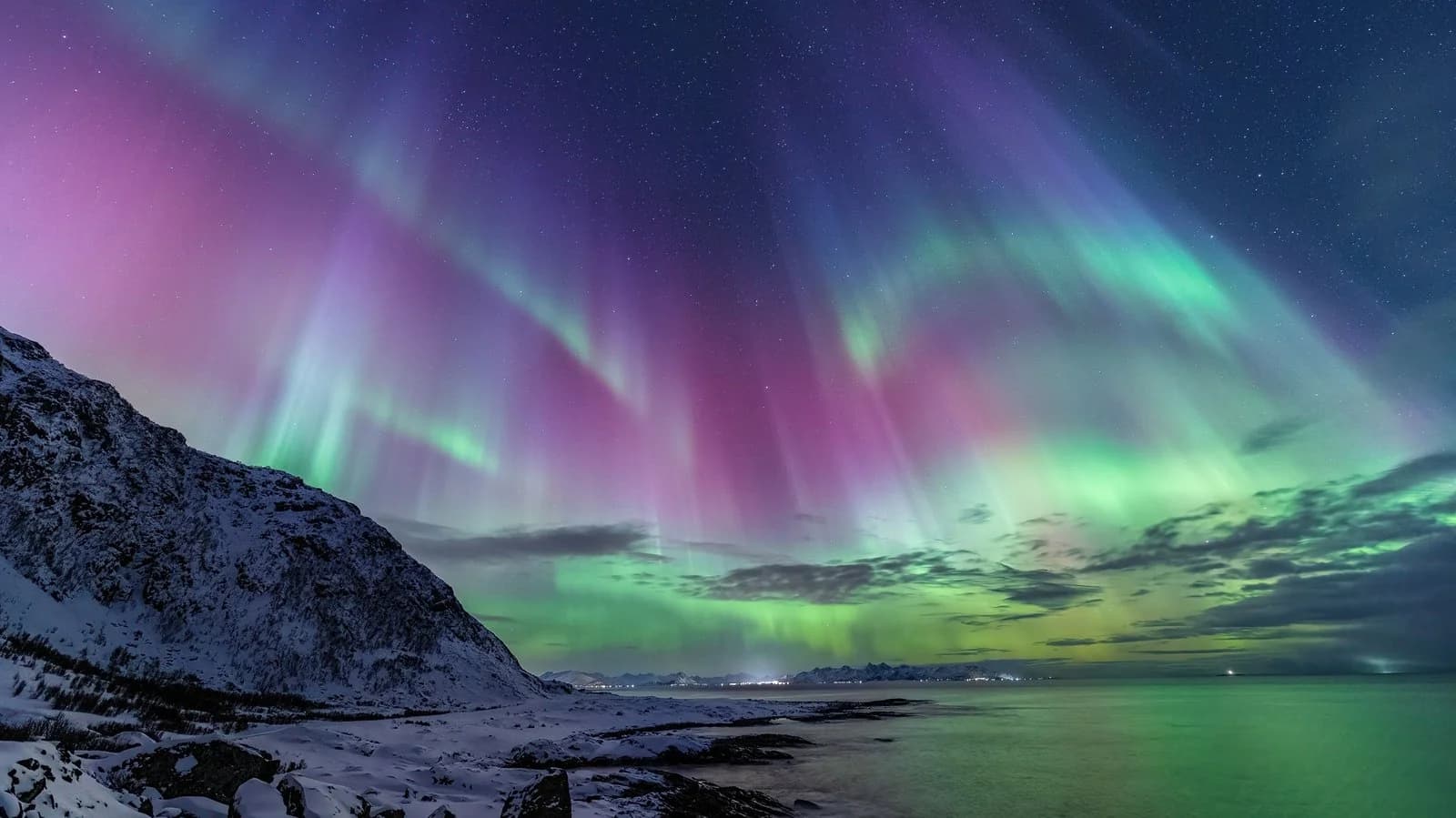
The connection to aurora is direct: aurora is caused by charged particles from the solar wind (and from CMEs) being channeled by Earth's magnetic field into the upper atmosphere near the poles, where they collide with atmospheric atoms and release light. More solar activity = more charged particles = more aurora. During solar maximum, the constant elevated level of solar wind produces aurora almost nightly at high latitudes, and CME-driven storms produce aurora at lower latitudes that normally never see it.
For the practical aurora viewing guide that uses this physics, see our Northern Lights 2026 article.
The 11-Year Cycle: A Brief History
Solar cycles have been observed continuously since 1755 (Cycle 1). We are currently in Cycle 25. The numbering reflects the convention established by Swiss astronomer Rudolf Wolf in the 1840s, who developed the sunspot number index that is still in use today.
Solar cycles vary significantly in strength. The strongest cycle of the modern era was Cycle 19 (peaked in 1957 to 1958), which had a peak sunspot number of around 285, the highest ever recorded. The weakest recent cycle was Cycle 24 (peaked in 2014), which had a peak sunspot number of only 116, the weakest since Cycle 14 in 1906. Cycle 25 was expected to be similar to or weaker than Cycle 24, but has significantly outperformed the forecasts, with a peak likely around 156 (the highest since Cycle 23).
A timeline of recent cycles:
| Cycle | Peak Year | Peak Sunspot Number | Notes |
|---|---|---|---|
| 22 | 1989 | 212 | Strong; 1989 Quebec blackout storm |
| 23 | 2000 | 180 | 2003 Halloween storms |
| 24 | 2014 | 116 | Weakest in a century |
| 25 | 2024 to 2025 | ~156 | Stronger than expected; May 2024 Gannon storm |
The Carrington Event of 1859, the most powerful solar storm ever recorded, occurred during the decline phase of Cycle 10. This is a key historical data point: the biggest storms do not necessarily occur at the absolute peak of the cycle. They can occur years into the decline phase, when the overall activity is moderate but the Sun's magnetic field still has the capacity to produce extreme events.
Why 2026 Still Matters: The Decline Phase Phenomenon
This is the most under-appreciated fact about solar cycles: the decline phase often produces some of the biggest individual storms of the entire cycle. There are several reasons for this:
Reason 1: Cumulative magnetic stress. During the rise to maximum, the Sun's magnetic field is building up stress. During the decline, that stress is being released, but the release is not smooth. It happens in bursts. Some of those bursts can be enormous even when the overall activity level is declining. The Carrington Event is the classic example: it occurred in September 1859, well past the peak of Cycle 10.
Reason 2: Persistent coronal holes. Coronal holes are regions of open magnetic field on the Sun's surface that allow solar wind to stream out at high speed. They become more prominent and longer-lived during the decline phase of a solar cycle. These high-speed streams produce moderate geomagnetic storms (KP4 to KP6) on a recurring basis, often every 27 days (the Sun's rotation period). These recurring storms are not as dramatic as CME-driven superstorms, but they produce more reliable aurora viewing at mid-latitudes.
Reason 3: Statistical probability. Solar maximum produces many storms, but the largest storms are statistically rare. The longer you stay at elevated activity levels, the more chances you have to roll the dice on a really big one. The decline phase keeps activity elevated for several years past the absolute peak, increasing the total number of opportunities for a major event.
Reason 4: The "tail" of solar maximum. Solar maximum is not a single moment; it is a period of typically 1 to 2 years when activity is at its highest. The "official" date of maximum is determined retrospectively, often 1 to 2 years after the fact, by examining the smoothed sunspot number curve. By the time solar maximum is officially declared, activity may have already been declining for a year. This is why being "past the peak" is not the same as "activity is low." The tail of solar maximum can extend for years.
The practical takeaway for 2026: Even though solar maximum was reached in 2024 to 2025, 2026 is still well within the elevated activity window. Aurora observers in mid-latitudes (the northern US, the UK, central Europe) will continue to see regular aurora opportunities through 2026 and into 2027. The frequency will gradually decline, but the chance of a major storm (KP7+) is still elevated above solar minimum levels. If you missed the May 2024 Gannon storm and have been waiting for another chance, 2026 still offers reasonable odds.
How Solar Flares and CMEs Differ, and Why It Matters
People often conflate solar flares and coronal mass ejections (CMEs), but they are physically different phenomena with different practical impacts on Earth.
A solar flare is a sudden flash of electromagnetic radiation (mostly X-rays and ultraviolet light) from a localized region of the Sun, usually associated with a sunspot group. Flares are classified by strength: A, B, C, M, X. A typical solar flare lasts minutes to hours. Because flares emit electromagnetic radiation (light), they travel at the speed of light and reach Earth in about 8 minutes after they occur on the Sun. The primary effect of solar flares on Earth is radio blackouts: X-rays from a flare ionize the upper atmosphere (the ionosphere) on the dayside of Earth, disrupting high-frequency radio communications. Flares do not directly cause aurora.
A coronal mass ejection (CME) is an eruption of plasma and magnetic field from the Sun's corona. CMEs carry billions of tons of charged particles at speeds of hundreds to thousands of kilometers per second. Because CMEs are made of physical material (plasma), they travel much slower than light, typically taking 1 to 3 days to reach Earth after they erupt from the Sun. When a CME's magnetic field interacts with Earth's magnetic field, it triggers a geomagnetic storm, which is what produces aurora. CMEs are the primary driver of aurora activity.
The connection: Solar flares and CMEs often occur together. A strong solar flare is frequently accompanied by a CME launched in the same direction. But not every flare produces a CME, and not every CME is associated with a flare. The biggest geomagnetic storms (and the best aurora) come from CMEs that are aimed directly at Earth and have a magnetic field oriented to interact strongly with Earth's field (specifically, a southward-oriented magnetic field, which is the opposite of Earth's northward field at the equator).
Practical implications for aurora chasers: When you check a space weather forecast, the relevant numbers are:
- Solar flare activity indicates the Sun is active. Flares are the warning sign that a CME may be coming. An X-class flare is a strong signal that a major CME may have been launched.
- CME detection: coronagraphs on satellites (specifically the SOHO and STEREO spacecraft) can detect CMEs as they leave the Sun. The critical question is whether the CME is "earth-directed." Many CMEs go off in other directions and miss Earth entirely.
- CME arrival time: once an earth-directed CME is detected, the arrival time at Earth is typically estimated at 1 to 3 days after the eruption. This is your aurora forecasting window.
- Magnetic field orientation: when the CME arrives at Earth, satellites measure its magnetic field orientation. If the field is southward, a major geomagnetic storm is likely. If it is northward, the storm will be modest. This is why aurora forecasts sometimes "bust." A promising CME arrives but its magnetic field is oriented the wrong way, and the aurora does not materialize.
For the practical aurora viewing guide, see our Northern Lights 2026 page. For dark-sky planning, see our moon phases 2026 calendar.
The KP Index: Your Practical Aurora Forecast
The KP index (Kp planetary index) is the global measure of geomagnetic disturbance, updated every 3 hours by the Geophysical Institute at the University of Alaska Fairbanks and NOAA's Space Weather Prediction Center. KP ranges from 0 (very quiet) to 9 (extreme). The relationship between KP and aurora visibility is roughly:
- KP0 to KP2: aurora visible only from the core aurora oval (northern Scandinavia, Iceland, northern Canada, Alaska, Antarctica).
- KP3 to KP4: aurora visible from northern Scotland, southern Scandinavia, northern US (Maine, Minnesota, Washington).
- KP5 to KP6: aurora visible from central UK, much of the northern US, central Europe.
- KP7 to KP8: aurora visible from southern UK, France, central Europe, most of the US.
- KP9: aurora visible from the Mediterranean, southern US, and possibly further. These events occur perhaps once per solar cycle.
During the decline phase of Solar Cycle 25 (2026 to 2027), KP5+ storms occur multiple times per month on average. KP7+ storms occur a few times per year. KP8 to KP9 storms are rare but possible. The May 2024 Gannon storm reached KP9 and produced aurora visible from essentially all of the United States, all of Europe, and parts of Asia.
To get KP forecasts, use the NOAA Space Weather Prediction Center (swpc.noaa.gov), the University of Alaska Fairbanks aurora forecast (gi.alaska.edu/monitors/aurora-forecast), or one of the many aurora forecasting apps (My Aurora Forecast, Aurora Pro, AuroraWatch UK). For real-time alerts when KP rises above a threshold you set, the AuroraWatch service from Lancaster University offers free email and push notifications.
What to Expect in 2026 and Beyond
For the rest of 2026: Expect continued elevated solar activity. Several KP5+ storms per month are likely, with occasional KP7 to KP8 events. The autumn equinox (September 2026) and spring equinox (March 2027) windows will see statistically higher activity due to the Russell-McPherron effect. See our Northern Lights 2026 article for details on this. The August 12, 2026 total solar eclipse occurs during this elevated activity window, and there is a real chance of aurora visible from Iceland or northern Europe that night.
For 2027: Activity will continue to decline, but slowly. 2027 will still be a significantly above-average year for aurora. The chances of a major (KP7+) storm are lower than 2026 but still elevated above solar minimum levels. Mid-latitude observers should continue to have regular opportunities.
For 2028 to 2029: Activity will approach solar minimum. Aurora at mid-latitudes will become rare again, returning to the "background" rate of one or two visible events per year from northern England or the northern US. The deep solar minimum is expected around 2030.
For 2030 to 2031: Solar minimum. Aurora is largely confined to the core aurora oval. Solar Cycle 26 will begin, with the first sunspots of the new cycle appearing around 2030 to 2031.
For 2033 to 2035: Solar Cycle 26 ramp-up. Activity will begin increasing again, with the next solar maximum expected around 2035 to 2037.
If you have been thinking about chasing aurora but have not made the trip, 2026 is still an excellent year to do it. The solar maximum advantage is gradually fading, but it is not gone yet. See our Northern Lights 2026 guide for the complete practical planning information.
What to Do Next
The most useful single action you can take is to set up KP alerts on your phone. Download an aurora forecasting app (My Aurora Forecast, Aurora Pro, or AuroraWatch UK), set your location, and enable push notifications for KP3+ (if you live at high latitudes) or KP5+ (if you live at mid-latitudes). When a notification fires, drop what you are doing, check the cloud forecast, and if skies are clear, go outside and look north. Most people who see aurora from mid-latitudes see it for the first time this way: by accident, when a notification fires and they happen to have clear skies.
For the moon-phase planning that determines whether aurora will be visible against a dark sky or a bright one, see our moon phases 2026 page. For the broader astronomy calendar, see our best stargazing nights 2026 master page. And for the practical aurora viewing guide (where to go, what to bring, how to photograph) see our Northern Lights 2026 article.
Explore More
- Northern Lights 2026: the companion article. This page explains why aurora happens; that page explains when and where to see it.
- Moon Phases 2026: moonlight is the single most under-appreciated factor in aurora viewing. Plan around new moons for the best experience.
- 2026 Supermoon Dates: bright full moons wash out faint aurora. Avoid these dates for aurora viewing.
- Meteor Showers 2026: the same dark-sky windows that favor aurora also favor meteor watching.
- August 12, 2026: Eclipse + Perseids Double Event: the biggest astronomy day of 2026, with a total solar eclipse during the day and elevated aurora potential that night.
Frequently Asked Questions
5 questions answered
Is the Sun still at solar maximum in 2026?
Why do the biggest solar storms happen after maximum?
What does solar maximum actually mean?
Will 2026 be a good year for aurora?
When is the next solar minimum and maximum?
Put this into action
Stop guessing. Use our professional tools to schedule, convert, and manage time zones perfectly, 100% free.
Track Sky EventsOfficial Sources & References
- NASA Science: official data and scientific overviews for astronomical events and missions.