Harvest Moon 2026: Exact Date, Time Zones & Complete Guide
Quick Answer
The 2026 Harvest Moon falls on Saturday, September 26, with peak illumination at 16:49 UTC (5:49 PM in London, 12:49 PM in New York, 9:49 AM in Los Angeles). It is the full moon closest to the September 23 autumnal equinox. What makes the Harvest Moon special is not its appearance but its timing. For 3 to 4 consecutive nights, the moon rises only 20 to 30 minutes later each evening instead of the usual 50 minutes, providing bright moonlight right at sunset for farmers harvesting late-season crops.
The Harvest Moon in 2026 falls on Saturday, September 26, 2026, with peak illumination at approximately 16:49 UTC, which is 5:49 PM in London, 12:49 PM in New York, 9:49 AM in Los Angeles, and 12:49 AM on September 27 in Beijing. The Harvest Moon is the full moon closest to the autumnal equinox (which in 2026 occurs on September 23 at 00:05 UTC, just under four days before the full moon). Because the September 26 full moon is closer to the equinox than the following October full moon (October 26), September 26 is unambiguously the 2026 Harvest Moon.
What makes the Harvest Moon unique is not its appearance (it looks like any other full moon) but its timing. For several consecutive nights around the Harvest Moon, the moon rises only 20 to 30 minutes later each evening instead of the usual 50 minutes. This means there is bright moonlight right at sunset for several evenings in a row, which historically gave farmers extra light to harvest their crops before the season ended. The effect is real, geometric, and specific to this time of year, and we will explain exactly why it happens below.
For the full moon names of every month, see our full moon names explained reference.
The Exact Time of the 2026 Harvest Moon: All Timezones
Here is the precise time of peak illumination for the September 26, 2026 Harvest Moon, converted to major timezones:
| Timezone | Local Time of Harvest Moon Peak |
|---|---|
| UTC | September 26, 2026, 16:49 |
| London (BST, UTC+1) | September 26, 2026, 17:49 |
| Berlin (CEST, UTC+2) | September 26, 2026, 18:49 |
| New York (EDT, UTC−4) | September 26, 2026, 12:49 |
| Chicago (CDT, UTC−5) | September 26, 2026, 11:49 |
| Denver (MDT, UTC−6) | September 26, 2026, 10:49 |
| Los Angeles (PDT, UTC−7) | September 26, 2026, 09:49 |
| Honolulu (HST, UTC−10) | September 26, 2026, 06:49 |
| Beijing (CST, UTC+8) | September 27, 2026, 00:49 |
| New Delhi (IST, UTC+5:30) | September 26, 2026, 22:19 |
| Tokyo (JST, UTC+9) | September 27, 2026, 01:49 |
| Sydney (AEST, UTC+10) | September 27, 2026, 02:49 |
| Auckland (NZST, UTC+12) | September 27, 2026, 04:49 |
Note the timezone twist: because the full moon peaks at 16:49 UTC, it falls on September 27 in East Asia, Australia, and New Zealand, while the Americas still see it on September 26. This is the same effect we discuss in our Blue Moon 2026/2027 article: the instant of full moon is a single moment, but the local date depends on your longitude. The Moon will look equally full on the evenings of September 25, 26, and 27 from anywhere in the world. The "exact" time matters only for scientific precision, not for visual observation. If you go out on any of those evenings, you will see a full (or essentially full) moon rising around sunset.
For the underlying lunar cycle that produces full moons, see our moon phases explained page.
The 3-Night Effect: Why the Harvest Moon Is Special
This is the most important fact about the Harvest Moon, and the one most people (including many astronomy writers) get wrong. Here is the precise explanation.
On average, the Moon rises about 50 minutes later each day. This is because the Moon orbits Earth in the same direction Earth rotates (both counterclockwise as seen from above the North Pole), so Earth has to rotate a little extra each day to "catch up" to the Moon's new position. The 50-minute figure is an average. The actual lag varies from about 25 minutes to about 75 minutes depending on the angle of the Moon's orbital path relative to the horizon.
The key insight is that this angle changes throughout the year. The Moon's orbit is tilted about 5 degrees from the ecliptic (Earth's orbital plane around the Sun), and the ecliptic itself is tilted relative to the horizon by an amount that depends on your latitude and the season. In autumn (in the Northern Hemisphere), the ecliptic makes a shallow angle with the eastern horizon at sunset. This means the Moon, traveling along (or near) the ecliptic, moves mostly parallel to the horizon each day, not mostly up. The geometric effect is that the Moon's daily rise-time lag shrinks dramatically.
Around the Harvest Moon, the moonrise lag drops from the usual ~50 minutes to as little as 20 to 30 minutes at mid-northern latitudes, and even less at higher latitudes. This means that for several consecutive evenings, the Moon rises around sunset, providing bright moonlight right at the time farmers would otherwise be losing daylight. The effect lasts for 3 to 4 nights centered on the full moon.
The 3-night effect, in practical terms:
- Night 1 (the night before full moon): the Moon rises about 30 minutes before sunset, just as the Sun is setting. By the time the sky is fully dark, the Moon is already 10 to 15 degrees above the horizon, providing bright moonlight.
- Night 2 (the night of full moon): the Moon rises right at sunset. The Moon is full and visible all night, rising in the east as the Sun sets in the west.
- Night 3 (the night after full moon): the Moon rises about 20 to 30 minutes after sunset. There is a brief gap of true darkness, but the Moon is up within half an hour of sunset, providing moonlight for most of the evening.
The effect is most pronounced at mid-northern latitudes (around 40 to 50°N). At the equator, the effect is minimal (the ecliptic is steep to the horizon year-round, so the moonrise lag is consistently close to 50 minutes). At very high latitudes (above 60°N), the effect can be even more dramatic, with the Moon rising earlier on consecutive nights rather than later.
Moonrise times for the 2026 Harvest Moon window in major cities:
| City | Sept 25 moonrise | Sept 26 moonrise | Sept 27 moonrise | Daily lag |
|---|---|---|---|---|
| London | 18:20 BST | 18:32 BST | 18:46 BST | ~13 min |
| New York | 18:16 EDT | 18:39 EDT | 19:03 EDT | ~24 min |
| Chicago | 18:12 CDT | 18:33 CDT | 18:57 CDT | ~22 min |
| Los Angeles | 18:15 PDT | 18:43 PDT | 19:13 PDT | ~29 min |
These moonrise times are approximate; the exact minute depends on your specific longitude and the local horizon. For precise moonrise times at your location, use a moonrise calculator like the one on our moon phases 2026 page.
For comparison with another kind of full moon event, see our 2026 supermoon dates page. Supermoons are full moons that occur when the Moon is near its closest approach to Earth, making them appear slightly larger and brighter than average.
Why It Is Called the "Harvest" Moon
The name "Harvest Moon" is the oldest of the named full moons and the only one that refers to a seasonal event rather than a specific calendar month. The name dates to at least the early 1700s in English, and similar names exist in many European languages. The reason is practical: before electric lighting, the bright moonlight around the Harvest Moon allowed farmers to continue harvesting their crops after the Sun had set, a significant advantage in late September, when crops are ripe but the days are getting shorter.
Other traditional names for the September full moon include:
- Corn Moon (Algonquin and other Native American traditions): referring to the time of harvesting corn.
- Barley Moon (English and Celtic traditions): referring to the barley harvest.
- Fruit Moon (Cherokee tradition): referring to the ripening of fruits.
- Autumn Moon (a more general name used in various traditions).
The "Harvest Moon" name became dominant in English partly through the influence of the Maine Farmers' Almanac, which beginning in the 1800s published lists of full moon names that combined Native American, colonial American, and European traditions. The same almanac tradition is responsible for the Blue Moon definition. See our Blue Moon 2026/2027 article for that story.
Cultural celebrations tied to the Harvest Moon:
- China: Mid-Autumn Festival (Zhongqiu Jie): one of the most important traditional Chinese holidays, celebrated on the 15th day of the 8th month of the Chinese lunar calendar, which always falls on or near the full moon closest to the September equinox. In 2026, the Mid-Autumn Festival falls on September 25, the night before the Harvest Moon. The festival is celebrated with mooncakes (round pastries filled with sweet or savory fillings), family gatherings, and lantern displays. The festival dates back over 3,000 years.
- Japan: Tsukimi (Moon Viewing): a Japanese festival celebrating the autumn moon, typically held in September or October depending on the lunar calendar. Traditionally involves displaying pampas grass and eating tsukimi dango (rice dumplings). In 2026, Tsukimi (jūgoya, the 15th night) falls on September 25.
- Korea: Chuseok: the Korean harvest festival, also celebrated on the 15th day of the 8th lunar month (same date as the Chinese Mid-Autumn Festival). In 2026, Chuseok falls on September 25. It is a major Korean holiday involving family gatherings, ancestral rites, and traditional foods including songpyeon (rice cakes).
- Vietnam: Tết Trung Thu: the Vietnamese mid-autumn festival, also on the same lunar date. Children carry lanterns and eat mooncakes.
The convergence of these major cultural festivals on the full moon closest to the September equinox is not a coincidence. It reflects the practical importance of the Harvest Moon across agricultural societies in the Northern Hemisphere.
For the broader moon-phase calendar, see our moon phases 2026 page.
The Harvest Moon and the Moon Illusion
The Harvest Moon is famous for looking enormous when it rises near the horizon. This is the moon illusion, a perceptual effect that makes the Moon appear much larger when it is low in the sky than when it is high in the sky, even though the Moon's actual angular size is essentially the same (in fact, the Moon is slightly smaller when it is high in the sky because it is slightly farther from the observer).
The moon illusion is not fully understood, but the leading explanation is that the brain compares the Moon to surrounding objects when it is low on the horizon (trees, buildings, mountains) and judges it to be large, while it has no such reference points when the Moon is high in the sky. You can test this by holding a coin at arm's length when the Moon is on the horizon and again when it is high in the sky. The coin will cover the same fraction of the Moon in both cases, demonstrating that the Moon's actual size has not changed.
The Harvest Moon is particularly associated with the moon illusion because:
- It rises near sunset, so people are often outside and looking east as the Moon comes up, providing maximum opportunity to see the effect.
- The Moon's orange color near the horizon (caused by atmospheric scattering, the same effect that makes sunsets red) makes the rising Moon visually distinctive.
- Foreground objects (trees, fields, buildings) are silhouetted against the rising Moon, providing the size-comparison cues that drive the illusion.
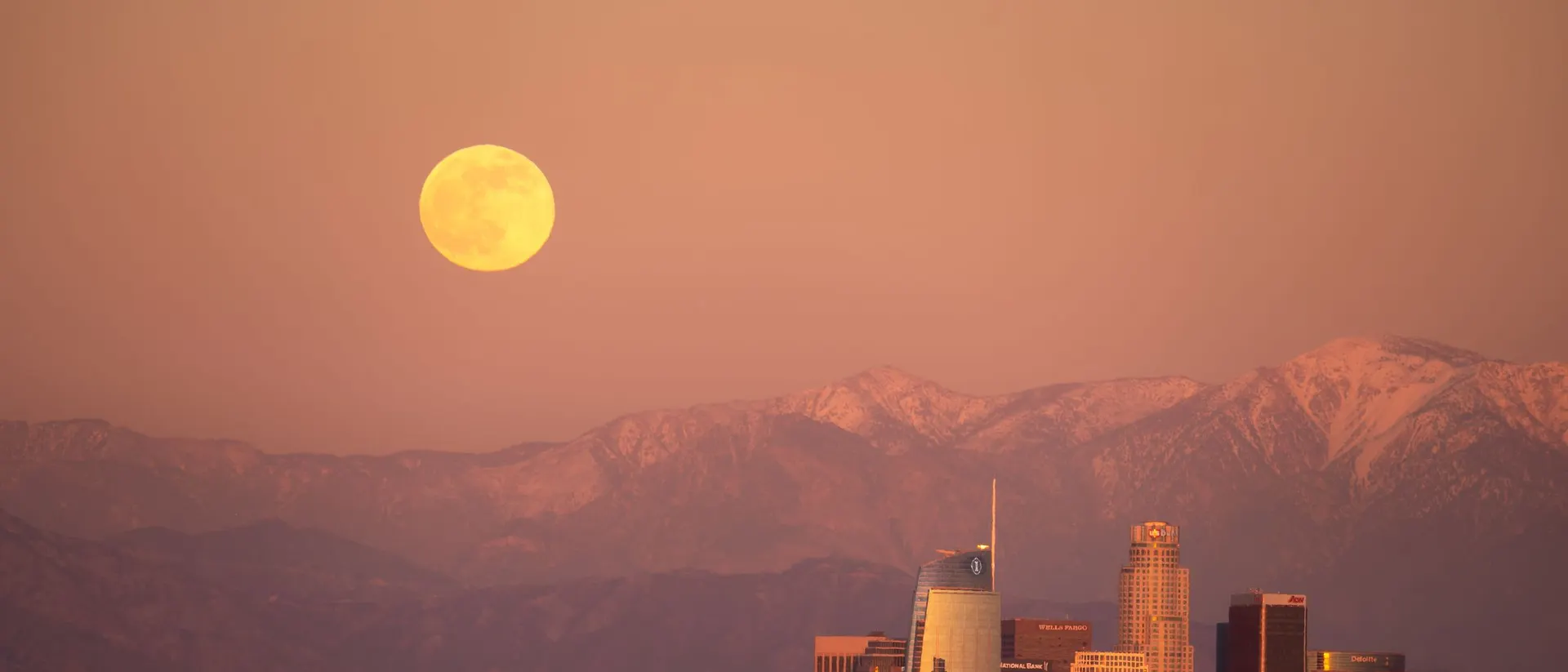
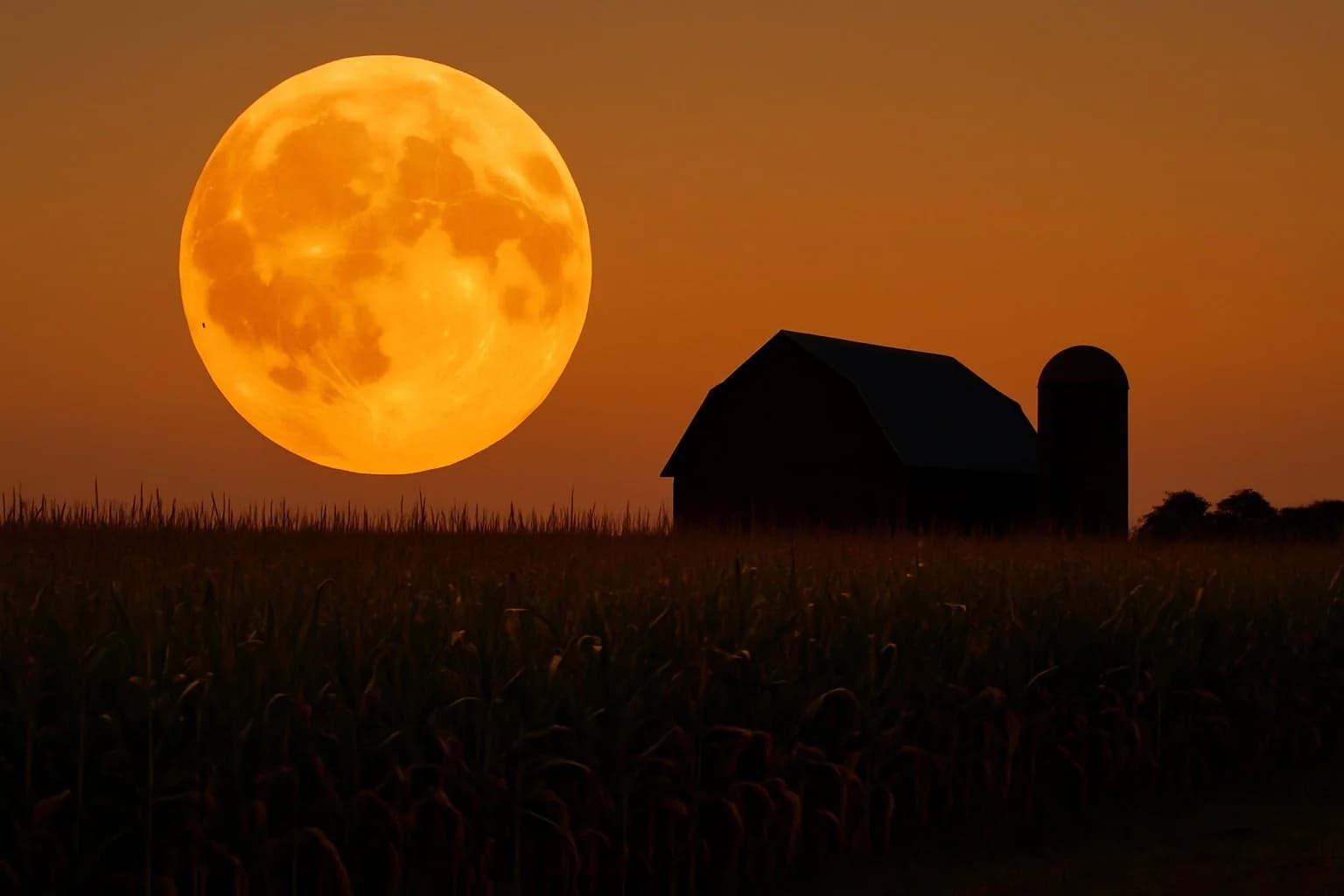
For photographers, the moon illusion is an opportunity: a Harvest Moon rising behind a recognizable foreground object (a tree, a barn, a city skyline) makes for iconic images. The trick is to be in position before moonrise, with your camera ready and your composition planned, because the Moon rises quickly and the best lighting (Moon just above the horizon, sky not yet fully dark) lasts only 10 to 15 minutes.
For more on the moon illusion and how to photograph it, see our why the moon looks bigger near the horizon page.
When the Harvest Moon Falls in October
The Harvest Moon is not always in September. Because the Harvest Moon is defined as the full moon closest to the autumnal equinox (which falls on September 22 or 23), and the full moon can fall on any date in September or early October, the Harvest Moon sometimes falls in October. Specifically, if the October full moon is closer to the September equinox than the September full moon, the October full moon becomes the Harvest Moon, and the September full moon is called the "Corn Moon" instead.
This happens about once every four to five years. The rule is: if the September full moon falls in the first week of September, the October full moon (about 29.5 days later) will be closer to the equinox, and becomes the Harvest Moon.
Verified future Harvest Moon dates:
| Year | Harvest Moon Date | Notes |
|---|---|---|
| 2026 | September 26 | just under 4 days after the September 23 equinox |
| 2027 | September 15 | 7 days before the September 23 equinox (full moon Sept 15 at 23:03 UTC; Sept 16 in European/Asian time zones) |
| 2028 | October 3 | 11 days after the September 22 equinox, an October Harvest Moon |
| 2029 | September 22 | falls about 1 hour before the September 22 equinox (the closest possible pairing) |
| 2030 | September 11 | 11 days before the September 22 equinox |
| 2031 | September 30 | 8 days after the September 23 equinox |
So the next October Harvest Moon is 2028, not 2031, and 2031's Harvest Moon actually falls in September. This illustrates how careful you have to be with Harvest Moon dates. The rule is "closest full moon to the equinox," and the calculation has to be done for each year.
For the full moon names of every month of 2026, see our full moon names explained page.
The Harvest Moon and the Autumn Equinox
The Harvest Moon is intimately tied to the autumnal equinox, which falls on September 22 or 23 each year in the Northern Hemisphere. The equinox is the moment when the Sun crosses the celestial equator from north to south, marking the official start of autumn. On the equinox, day and night are roughly equal in length everywhere on Earth.
In 2026, the autumnal equinox falls on September 23, 2026 at 00:05 UTC, which is 1:05 AM in London, 8:05 PM (September 22) in New York, 5:05 PM (September 22) in Los Angeles, and 8:05 AM in Beijing. This is just under 4 days before the Harvest Moon, making the 2026 Harvest Moon one of the closer-to-equinox Harvest Moons of recent years.
For more on the equinox itself, see our autumn equinox 2026 page.
What to Do on Harvest Moon 2026
The best way to experience the Harvest Moon is to be outside on the evening of September 26, 2026, looking east as the Moon rises. The Moon will rise around sunset (the exact time depends on your location; check a moonrise calculator for your city). Here is the ideal timeline for the evening:
- 30 minutes before sunset: find a location with a clear view to the east. The Moon will rise in the east-northeast.
- At sunset (around 6:30 to 7:30 PM local time, depending on your latitude): the Moon rises, looking large and orange due to the moon illusion and atmospheric scattering.
- 30 to 60 minutes after moonrise: the Moon climbs higher, the orange color fades to pale yellow, and the Moon becomes brighter as it gains altitude. This is the best time for photography. The Moon is high enough to clear most foreground obstacles but still low enough to be composed with landscape elements.
- Through the rest of the night: the Moon is high and bright, beautiful but less dramatic than at moonrise.
If you miss September 26, the nights of September 25 and September 27 are nearly as good. The Moon will look essentially full on both nights, rising 25 to 30 minutes earlier (Sept 25) or later (Sept 27) than on the 26th. This 3-night window is the practical Harvest Moon observing window.
For photographers: the Harvest Moon rising behind a recognizable foreground (a tree, a barn, a city skyline) is iconic. Plan your location in advance, arrive early, and have your camera ready. A telephoto lens (200 to 400mm) will make the Moon look dramatically large relative to foreground objects, but you need to be far enough from the foreground for the composition to work.
For the moon-phase calendar that gives the precise full moon time for every month, see our moon phases 2026 page.
What to Do Next
The 2026 Harvest Moon falls on a Saturday, which makes it an excellent opportunity for a moonrise-watching outing. Find a location with a clear eastern horizon, a hill, a field, a beach, or even a tall building with an east-facing window, and be in position by sunset on September 26. If the weather cooperates, you will see one of the most reliable celestial events of the year.
For the full moon calendar that helps you plan around the Harvest Moon and every other full moon in 2026, bookmark our moon phases 2026 page. For the broader autumn astronomy calendar, including the Orionid meteor shower in October and the Leonids in November, see our meteor showers 2026 page. And for the astronomy event of the year, see our August 12, 2026 double event page: a total solar eclipse by day and the Perseid meteor shower by night, all in a single 24-hour window.
Explore More
- Full Moon Names Explained: the complete guide to every month's traditional full moon name, from Wolf to Cold to Strawberry.
- Moon Phases 2026: every full moon, new moon, and quarter moon for 2026, with exact UTC times and timezone conversions.
- Autumn Equinox 2026: the equinox that defines the Harvest Moon, occurring just under 4 days earlier.
- What Is a Supermoon?: how some full moons end up closer and brighter than average.
- Why the Moon Looks Bigger Near the Horizon: the moon illusion, explained, and why the Harvest Moon is its best-known example.
Frequently Asked Questions
6 questions answered
When is the Harvest Moon in 2026?
What time should I look for the Harvest Moon?
Why is it called the Harvest Moon?
Is the Harvest Moon always in September?
Is the Harvest Moon a supermoon in 2026?
How long does the Harvest Moon last?
Put this into action
Stop guessing. Use our professional tools to schedule, convert, and manage time zones perfectly, 100% free.
Track Sky EventsOfficial Sources & References
- NASA Science: official data and scientific overviews for astronomical events and missions.